“Go and exercise” can sound like another assignment. “Want to help this spaceship get through the next section?” gives a child something concrete to try. A game will not appeal to everyone, but for a child who already enjoys interactive play, it can be an inviting first step.
The aim is to find a movement experience they want to return to. Start with curiosity: do they enjoy rhythm, sports, a funny pose or a game with time to think? Let that answer shape the first choice, rather than deciding that every child needs the most vigorous option.
What research says about participation
In a 24-week randomized trial involving 46 children with overweight or obesity, a home exergaming program had high adherence and enjoyment ratings, with improved measured activity. Participants received a game schedule and coach support as well as equipment. It is evidence for a supported routine, not a promise that installing a game alone creates a habit.
A naturalistic trial of active games at home found no increase in overall measured activity simply from providing the games. This is a helpful distinction for parents: the invitation, routine and surrounding choices matter.
Another small dance-game trial with adolescent girls found improved exercise self-efficacy and favorable self-reported changes, but no significant difference in accelerometer-measured activity. Feeling more confident is worthwhile; it should not be confused with a measured change in all-day movement.
Give the first turn a goal they can reach
Choose one small task: get the camera to recognize a movement, notice the on-screen cue, or complete one deliberate action. A new player is learning both the control and the rule. A missed input can feel like failure even when the camera simply cannot see the intended movement.
Try saying, “Let’s see which movement the game recognizes,” rather than “You need to score higher.” Take a practice turn yourself, including a mistake. A child can then see that adjustment is part of learning a game.
PulseWing gives an active player a spaceship task driven by jogging and lane movement. Awkward Pose Studio asks a player to respond to a pose target. The game artwork below can help a child choose a theme before you launch; preview the full tutorial and sounds together.
Make the next invitation easy to accept
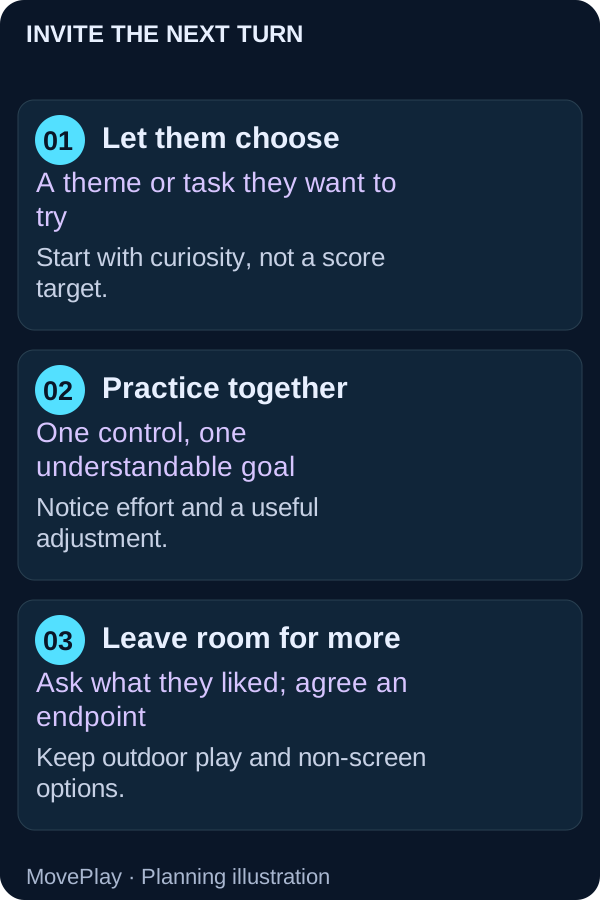
- Offer a choice: “The spaceship or the pose game?” Keep both options suitable for the available space.
- Agree an endpoint: one practice turn and one shared attempt, with permission to finish earlier.
- Praise something specific: noticing a cue, trying again or explaining a rule.
- Ask what to change: a different game, less audience attention or another time of day.
These are family activity ideas, not a research-tested MovePlay program. You do not need to copy a study’s session length or schedule to have a useful first experience.
Let competition fit the child
Some players love a score challenge. Others enjoy exploring the control or teaching an adult. Try a cooperative goal such as taking turns to understand a tricky cue. Avoid comparing siblings’ scores as if they measured effort, fitness or confidence; unfamiliarity and camera framing can affect a turn.
If the child dislikes performing in front of others, offer a private practice or an offline activity. A declined turn is useful information about what they prefer, not evidence that they lack motivation.
Keep the rest of the day in view
Swap part of an existing seated entertainment period when that fits the family, rather than adding another screen session by default. Keep outdoor play, rest and other enjoyable activities in the plan. Read how active gaming differs from reducing screen time when setting boundaries.
The family setup guide covers space, privacy and adult-managed access. For more players, use the fair-turn game-night plan. For a quieter decision task, explore the puzzle and casual collection before choosing a full-body game.
Try a game before deciding on a routine
Read the movement and current access shown below, test the camera, and try the current free selection if its controls suit your child. Pro titles need sign-in and verified access. An adult should manage account and purchase choices. Start with a game the child is curious about; the best first outcome is discovering whether they want another turn.
Sources and further reading
- Home-based exergaming among children with overweight and obesity: a randomized clinical trial (2018) — 24-week randomized trial, 46 children.
- Impact of an active video game on healthy children’s physical activity (2012) — Naturalistic randomized trial.
- Twelve weeks of dance exergaming in overweight and obese adolescent girls: Transfer effects on physical activity, screen time, and self-efficacy (2017) — Small randomized trial.
Games to preview
Review the controls, play area and access label before opening a game.

PulseWing
Jog to fire through a space-interceptor campaign, dodge lasers and save a missile volley for the boss.
Controls: Jog to fire, move sideways, squat under lasers, clap overhead for missiles.
First-round idea: Try each movement control before chasing the boss.
Free through 2027-07-29 (UTC)
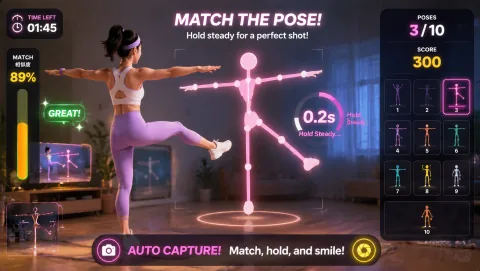
Awkward Pose Studio
Copy a body silhouette before the countdown finishes and hold it for the match.
Controls: Arrange your arms and body to match the displayed pose.
First-round idea: Read the whole silhouette before moving into the shape.
Pro · sign-in required