Multiplayer & Group Games

Head-to-head motion games — one screen, any crowd

Take turns competing for the high score. One webcam, one screen, unlimited players. These motion games create natural competitive moments that get everyone up and moving — perfect for family game night, classroom parties, or just getting off the couch.

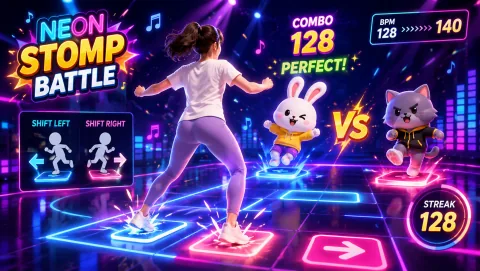
NeonStompBattle — competitive rhythm side-stepping
NeonStompBattle Side-step to the beat as BPM ramps up — post your score, challenge someone to beat it.
1

Player 1 plays a round

One player steps up, faces the webcam, and plays a full game session. Their final score is recorded — screenshot it, write it on a leaderboard, remember it.

2

Next player takes the stage

Reset the game, swap players. No controller handoff, no profile switching. The next person just steps in front of the camera. The competitive pressure is immediate.

3

Crown the winner

Best score wins. Play elimination rounds, best-of-three, or full round-robin. The format is completely flexible — no software setup required for any group structure.

Best for

Families wanting active game nights, teachers running classroom parties, and any social gathering that needs to get people moving.

01

Social Bonding Through Friendly Competition

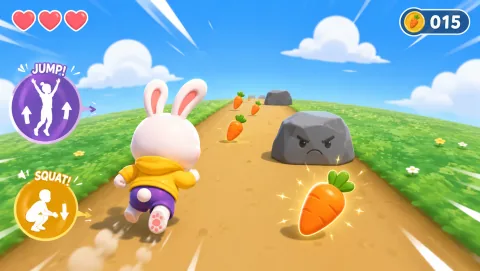
Shared physical challenge creates social cohesion. When a group watches someone attempt BunnyHop or AwkwardPoseStudio, the combination of effort, comedy, and genuine competition generates positive shared emotion — the same dynamic that makes sports viewing socially bonding, but with full participation rather than passive watching.

02

Zero Hardware for Extra Players

Traditional multiplayer games require controllers, headsets, or additional hardware for each player. MovePlay group play needs one screen and one camera — shared by all players sequentially. Ten people can compete with exactly the same setup as one person. This makes it uniquely scalable for large family events or full classroom settings.

03

Classroom & Party Ready

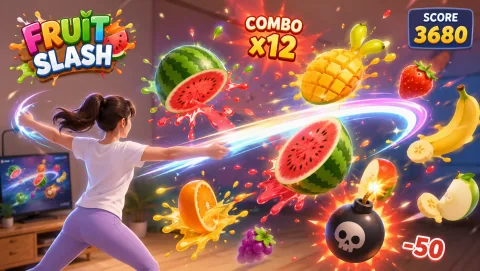
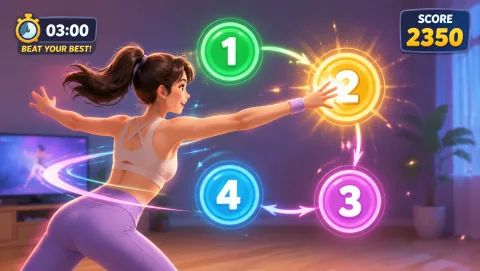
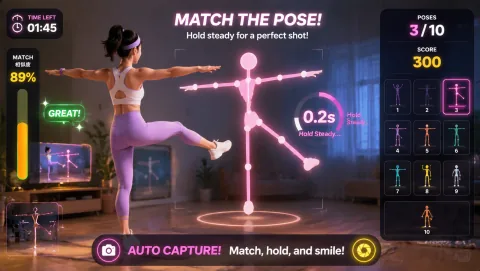
AwkwardPoseStudio is particularly effective in group settings — the pose-matching gameplay is immediately hilarious to observe, creating entertainment for the group even when it's not their turn. WhackAMole and FruitSlash generate strong crowd reactions through their fast, physical gameplay. These aren't just fun to play — they're fun to watch.

The Science

Why group active play matters

Three research-backed reasons why social physical activity outperforms solitary exercise.

Social bonding through shared physical experience

Synchronised and shared physical activity triggers endorphin release and oxytocin production — the neurochemical basis of social bonding. Research on group exercise consistently shows that participants feel closer to co-exercisers after shared physical activity than after equivalent shared sedentary activities, and report higher positive affect and lower pain thresholds.

Dunbar et al. (2012), Proc R Soc B — synchronised physical activity increases pain threshold via endorphin release, signalling social bonding.

Competition increases physical effort

Social facilitation research shows that the mere presence of observers increases effort output during physical tasks. In competitive contexts, this effect is amplified — people push harder when competing for a visible leaderboard position. The group score-competition format of these games leverages this effect, producing higher physical effort and better fitness outcomes than solitary play.

Zajonc (1965), Science — social facilitation: performance improves on practiced tasks in the presence of an audience.

Family activity improves children's physical habits

Children whose parents participate in physical activity with them are significantly more likely to develop lifelong active habits. Parental modelling is the most powerful predictor of childhood physical activity, outperforming school-based PE programmes. Family motion game sessions create exactly this shared active experience, with parents demonstrating that movement and play are connected to the same activity.

Trost & Loprinzi (2011), Am J Prev Med — parent physical activity is the strongest predictor of child physical activity levels.
How to run group play

Formats that work for any group

MovePlay supports unlimited group size — here are three proven competition formats for different settings.

Get your group moving

One screen. Any number of players. Instant fun.

No extra hardware for extra players. No software setup. Open the Game Hub, pick a game, and your group competition starts in 30 seconds.

Open Game Hub →

FAQ

Group play — common questions

Can multiple people play at the same time?

Currently, MovePlay games are single-player with one player per camera session. Group play works via take-turns score competition — one player at a time, with everyone else watching and competing for the leaderboard. This format actually generates more group engagement than simultaneous play, because all attention focuses on the single player's performance. True simultaneous multiplayer is on the product roadmap.

What's the best game to start with for a large group?

AwkwardPoseStudio is our top recommendation for first-time group play. The pose-matching mechanic is instantly readable to spectators (they can see whether the player is matching the silhouette), the 3-second timer creates natural tension, and the inherent comedy of awkward poses generates consistent group laughter. It also has the fastest individual rounds, allowing rapid player rotation.

Can teachers use this for classroom PE or parties?

Yes, and many do. The educator plan unlocks classroom-specific features. For class parties, AwkwardPoseStudio elimination tournaments are a tried-and-tested format — the teacher runs the bracket, students take turns, the class spectates. For PE brain breaks, the entire class participates sequentially in 10-minute rotations. See our Indoor Field Day Activities for Schools for a complete classroom tournament template.

How do I keep score across multiple rounds?

The simplest method is a physical whiteboard or paper leaderboard — each player writes their score after their round. For digital tracking, the game's end screen shows the final score clearly — take a phone photo to preserve it. For regular family or classroom competitions, a shared spreadsheet tracked over weeks creates a running championship leaderboard that sustains long-term engagement.