Lead With the Outcome
Start from what families or teachers want: calmer routines, more movement, better focus, or a way to make indoor time feel less stuck.
Wind-down play
Even active play needs a calm landing, especially at night.

Best for families balancing movement with bedtime routines.
Start from what families or teachers want: calmer routines, more movement, better focus, or a way to make indoor time feel less stuck.
The best activity is the one that starts in under a minute. Browser-based movement games work well because setup friction is low.
Scores, streaks, and short rounds make movement feel like play instead of a task someone has to enforce.
Practical playbook
Keep the first session small, specific, and easy to stop. The goal is not to create a perfect workout. The goal is to make active play feel like a normal option.
Begin with a single short active wind-down games before bed round to test the real setup: camera position, lighting, and floor space before inviting a group.
Let the first player choose the opening game, then rotate so everyone gets a turn shaping the session.
Track completion, not perfection: one round finished is already a useful data point.
Why it works
People are more likely to start when the commitment feels small. A five-minute movement game is easier to accept than a vague promise to exercise.
Scores, streaks, and visible progress give kids and adults a reason to try again without turning the session into a lecture.
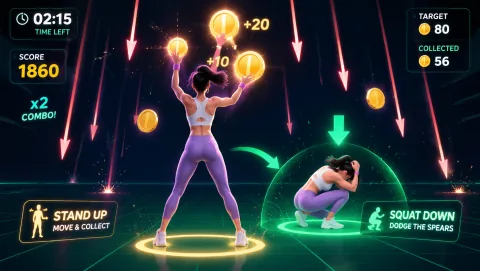
Standing up, reaching, squatting, or reacting can break the passive screen loop and make the next transition easier.
Start here
These games are browser-based and use body movement through a webcam. No controller or download required.
Fruit Slash
Slash fruits with sweeping arm swipes — the more you slash, the higher you score, and the fruit keeps speeding up.
02
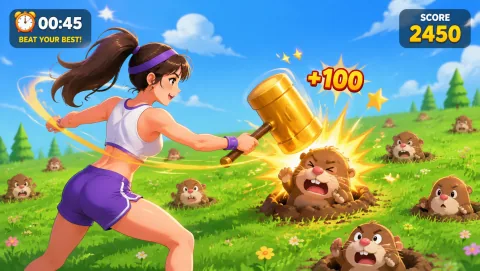 Whack A Mole
Moles pop up — smash them hard. Miss one and the rhythm spirals out of control.
03
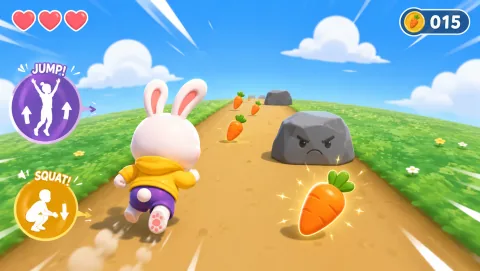 Bunny Hop
Dodge left and right, duck under obstacles, leap high — cycle all three moves to survive the endless course.
04
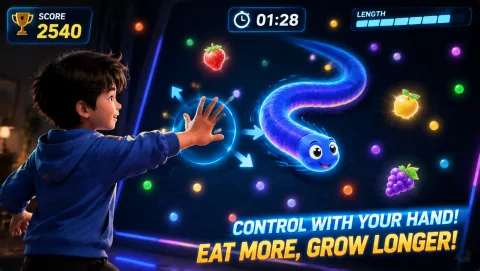 Snake
Guide the snake by waving your arm in the direction you want to go — the longer it grows, the harder it is to turn.
Simple routine
More options
Keep it realistic
Clear the floor, keep the camera pointed at the play space, start with low intensity, and stop if anyone feels pain, dizziness, or discomfort. For classrooms or groups, use short turns and a visible stop signal so the activity stays fun and contained.
Common questions
The activity should be simple to start, physically engaging, and rewarding enough that kids want to repeat it.
Most ideas work with body movement, open floor space, and a browser. No controller or dedicated fitness gear is required.
Begin with a five-minute round, watch which movement patterns kids enjoy, and rotate games before the activity feels stale.
Move first, scroll later