At-home movement for adults

Active games for adults at home that are easy to start

Active games can make it easier to add a few minutes of movement to a day at home because the session has a clear rule, immediate feedback and a natural stopping point. You do not need to turn the living room into a gym or commit to a long workout. The useful question is simpler: what kind of movement fits your space, energy and attention right now?

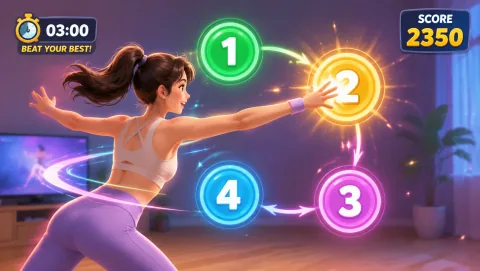
Reaction gameplay preview
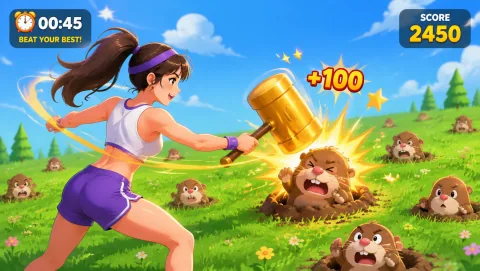
Reaction 4 numbers scatter to the corners — slap them in order with hands and feet. The timer shortens fast; slow reactions cost points.
Best for

Best for adults restarting a movement habit, working from home, or looking for a more playful alternative to a formal workout video.

01

Start with the lowest-friction version

MovePlay games use a webcam and browser-based motion tracking so actions such as reaching, steering, posing, stepping or squatting can become game controls. Some titles stay mostly in place; others need more full-body framing. Choose the control style before choosing the theme.

The best first session is the one you can begin without rearranging the room for ten minutes.

For a quick break:

  1. open one game that matches your available space;
  2. make sure the camera sees the body part used by the control;
  3. play one or two short rounds;
  4. stop at a clean end point instead of turning the session into an obligation.

If you want another round, continue. If not, the session still did its job: it interrupted a long period of sitting with an intentional change of posture and attention.

02

Choose the movement style that fits today

  • Low-travel hand or upper-body play — Use this when you have little floor space, want a quieter session or do not want repeated lower-body movement. Hand-led, pointing, reaching and contained pose games can usually be played closer to the camera than jumping or wide lateral movement.
  • Standing reaction and steering — These games ask you to shift position, reach to targets or steer with body movement while remaining inside a relatively contained zone. They work well for a short break between desk sessions because setup is simple and the movement is easy to scale down.
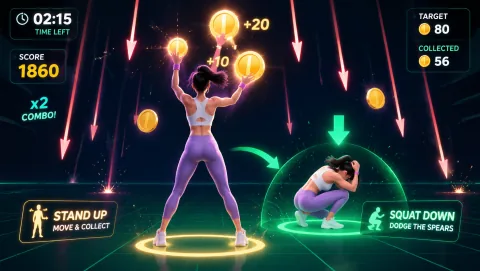
  • Larger full-body movement — Squats, knee lifts, bigger arm sweeps, jumps and wider lateral movement need more framing and a clearer floor. Use these only when the room and your own comfort make them appropriate. A game being more physically demanding does not automatically make it a better choice.
03

Match the room before you start

A motion game should fit the room, not force the room to fit the game.

Check four things:

  • Camera framing: can the camera see the hands, torso or full body that the game needs?
  • Movement footprint: can you complete the control without reaching furniture, cables, pets or another person?
  • Screen readability: if you step farther back, can you still read targets and instructions?
  • Surface: avoid slippery or unstable flooring for games with repeated stepping or squatting.

For a more systematic setup, use the webcam game setup guide (/guides/webcam-game-setup) and the small-space game guide (/guides/small-space-webcam-games).

04

Good starting categories

Useful starting categories include:

  • reaction games for short target-based rounds;
  • hand-tracking games for low-travel play;
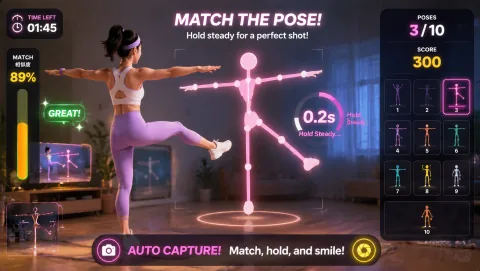
  • pose games for readable whole-body interaction without constant travel;
  • squat or dodge games when full-body framing and floor space are available;
  • rhythm games when the player prefers a repeated timing pattern.

Browse the current webcam game collection (/webcam-games/) or filter by movement and space in collections (/collections/).

05

What active games can and cannot claim

A game can create a reason to stand, reach, shift posture or repeat a movement. That is a product fact when the control requires those actions.

It is different from claiming that a game:

  • causes weight loss;
  • burns a fixed number of calories;
  • improves cardiovascular fitness;
  • treats pain or mobility problems;
  • replaces strength, aerobic or rehabilitation programmes.

MovePlay should not make those claims without appropriate evidence. If your goal is medical rehabilitation, symptom management or a prescribed exercise programme, follow qualified professional guidance rather than a general game guide.

06

Make repeat sessions easier

If you enjoy the format, reduce the number of decisions needed next time.

  • Bookmark one low-travel game and one more active game.
  • Keep the camera position stable if possible.
  • Tie the session to an existing transition such as closing work, waiting for dinner or taking a scheduled break.
  • End while the experience still feels easy to repeat.

The objective is not to prove discipline. It is to make a short movement option available when you want one.

07

Choose your next step

  • Browse webcam games (/webcam-games/)
  • Find small-space games (/collections/small-space-games/)
  • Set up the camera and room (/guides/webcam-game-setup)
  • Learn how browser body tracking works (/help/how-webcam-body-tracking-works)
Choose by constraint

Start with the situation, then choose the game

These are practical starting points based on each game’s actual control style. Test the camera and room before extending the session.

Your situationStart withWhy it fits
I have two minutes and little spaceLaser Eyes or Cyber KnotHead or hand control keeps the footprint contained while you learn the camera loop.
I want a visible reaction challengeReaction or Fruit SlashTargets and swipes make the action obvious and give a short round a clear finish.
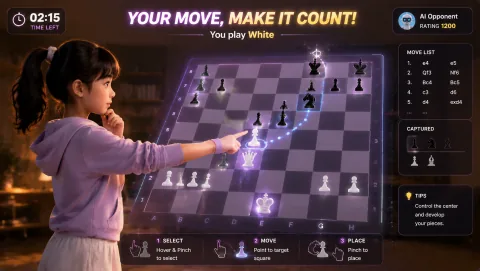
I need a quieter resetSnake or Gesture ChessBoth support slower, more contained play when jumping or large steps do not fit the moment.

Practical playbook

How to make this work today

Keep the first session small, specific, and easy to stop. The goal is not to create a perfect workout. The goal is to make active play feel like a normal option.

Why it works

Use behavior design, not pressure

Active play is a legitimate movement entry point

WHO includes active play in its description of physical activity. That supports treating a short game as one practical way to interrupt sitting, not as a claim that every session has the same health effect.

Technology should remove friction

ACSM’s fitness-trend reporting continues to place mobile apps and data-driven technology among important fitness directions. For MovePlay, the useful interpretation is simple feedback and low setup—not more dashboards.

A small repeatable cue beats a heroic plan

The page works best when the reader can name a cue, start one round, and stop cleanly. The next session can be evaluated by whether it was easy to begin and repeat.

Simple routine

A practical 10-minute at-home session

This is a play structure, not an exercise prescription.

  1. Minutes 0–2: Setup and easy round: choose a contained game, confirm camera framing and learn the control without chasing a high score.
  2. Minutes 2–7: Two or three scored rounds: stay with the same control long enough to understand the feedback. Switching games every minute adds setup cost without necessarily adding value.
  3. Minutes 7–10: Lower-travel finish: end with a hand, pose or slower target game if you want a calmer transition back to work or another activity.
  4. You can shorten the session to one round or extend it if you want. MovePlay does not need a fixed calorie, heart-rate or duration target to be useful as interactive play.

More options

Keep the rotation fresh

Keep it realistic

Adjust the session to your space and energy

Clear the floor and camera area, begin with a smaller range of motion, and choose seated or hand-tracking options when standing play is not a good fit. Stop if a movement causes pain, dizziness, or discomfort.

Questions adults ask

FAQ

Do active games replace a workout?

They do not need to. Browser motion games can add interactive movement to the day, but MovePlay does not position ordinary game sessions as a substitute for an exercise, sport, physiotherapy or medical programme.

Can I use MovePlay in a small apartment?

Yes, if you choose a control style with a small movement footprint. Hand, pose and contained steering games generally need less floor space than jumping, running-in-place or wide lateral games. Check the requirements of the individual title.

Do I need a controller or console?

MovePlay is designed around webcam-tracked movement in a web browser, so supported games do not require a conventional game controller. The device still needs a compatible browser, camera and sufficient performance for real-time tracking.

How long should a session be?

There is no required duration. One or two short rounds can be a complete session. Choose a length that fits the context and your comfort rather than following a universal number from a game website.

What if standing play is not a good fit?

Choose a game whose controls can be performed with the movement range available to you, such as hand- or upper-body-led play. Do not assume every MovePlay title is suitable for seated play; use current game metadata and instructions.

Choose your next step

Make the next move fit the moment.

Use the page that matches what you need now: a game, a setting, a tool, or a plan.

Move first, scroll later

Turn a short screen session into active play.

Play Reaction now

Preview the actual game controls

PulseWing — Game artwork

PulseWing

Jog to fire through a space-interceptor campaign, dodge lasers and save a missile volley for the boss.

Controls: Jog to fire, move sideways, squat under lasers, clap overhead for missiles.

First-round idea: Try each movement control before chasing the boss.

Free through 2027-07-29 (UTC)

Mine Hook — Game artwork

Mine Hook

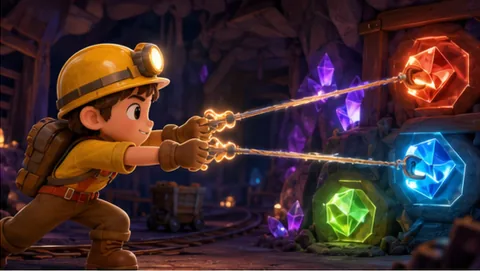
Aim a mining claw, drop it with a squat and reel a gem back before heavy rocks eat the clock.

Controls: Lean to aim; squat to extend the claw; rise to reel it back.

First-round idea: Choose a gem path and bring it back without a heavy rock.

Pro · sign-in required

Wasteland Blade Rush — Game artwork

Wasteland Blade Rush

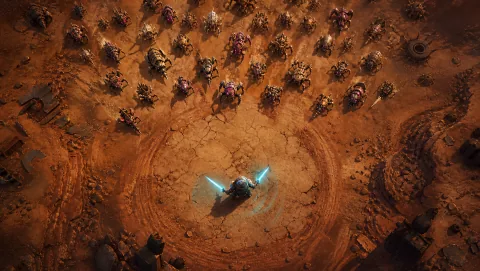
Send blade waves through a monster swarm and side-step charges to protect your armor.

Controls: Swing arms for blade waves, cross-block and move sideways to dodge.

First-round idea: Clear a swarm while keeping armor through a charging attack.

Pro · sign-in required

Check current free games and plans →