ADHD & movement

Movement games that channel ADHD energy into focus and fun

Children with ADHD benefit enormously from physical movement — aerobic activity improves attention, executive function, and mood for hours afterward. These games are designed around the short, high-reward format that works best for ADHD brains.

Whack A Mole gameplay preview
Whack A Mole Moles pop up unpredictably — smash them hard. Instant feedback, constant novelty, perfectly matched to ADHD engagement patterns.
Best for

Parents and teachers supporting children with ADHD who need physical movement, immediate reward feedback, and short-burst sessions to regulate energy and improve focus.

01

Short Sessions Work Best

The ADHD brain responds to novelty and immediate reward — and it disengages from extended, repetitive tasks. Game rounds of 5–8 minutes align with this cognitive profile. Multiple short sessions across the day (morning, after lunch, before homework) are significantly more effective for ADHD children than one extended exercise session, and far more achievable as a daily habit.

02

Immediate Feedback Equals Motivation

ADHD brains experience delayed reward as essentially invisible — motivation requires immediate feedback. MovePlay games deliver instant visual and audio reward for every correct action: a mole smashed, a fruit slashed, a number tagged. This high-frequency reinforcement schedule is precisely what the ADHD dopamine system responds to, maintaining engagement and reducing the boredom-driven abandonment that traditional exercise creates.

03

Movement Before Homework

Hillman et al. (2009) published research showing that 20 minutes of moderate aerobic exercise before academic tasks produced measurable improvements in attention, processing speed, and working memory in children with ADHD — effects that lasted approximately 60 minutes post-exercise. A movement game session before homework creates a scientifically-supported cognitive preparation window that reduces homework resistance and improves output quality.

Practical playbook

How to use movement games effectively for ADHD

The structure matters as much as the activity. Short, defined rounds with a clear start and stop — and a direct transition to the next activity — work best for ADHD children. Avoid open-ended "play as long as you want" sessions which can lead to dysregulation.

Why it works

The science linking exercise and ADHD brain function

20-minute exercise improves executive function

Hillman et al. (2009) demonstrated in a controlled study that 20 minutes of moderate aerobic exercise significantly improved performance on executive function tasks — including attention, inhibitory control, and cognitive flexibility — in children with ADHD. Crucially, these improvements were observed immediately post-exercise and persisted for up to 60 minutes. The effect was comparable in magnitude to stimulant medication effects on similar tasks.

Aerobic exercise reduces ADHD symptoms

Pontifex et al. (2013) published research in the Journal of Pediatrics showing that a single bout of moderate aerobic exercise reduced ADHD symptoms — including inattention and hyperactivity — in some children comparably to pharmacological intervention. While this does not replace medication treatment, it confirms that physical activity is a powerful evidence-based intervention for symptom management, particularly when exercise is an engaging, preferred activity.

Game reward loops match ADHD dopamine patterns

ADHD is fundamentally associated with dysregulation of the dopaminergic reward system — specifically, reduced sensitivity to delayed rewards and heightened motivation from immediate, variable reinforcement. Game reward loops — which provide frequent, unpredictable positive feedback — align precisely with this neurological profile. Movement games that combine physical activity with game reward mechanics engage ADHD children at both the physiological and motivational level simultaneously.

Simple routine

After-school movement to homework routine

  1. 3 minutes: WhackAMole — immediate engagement, high energy release, short and defined.
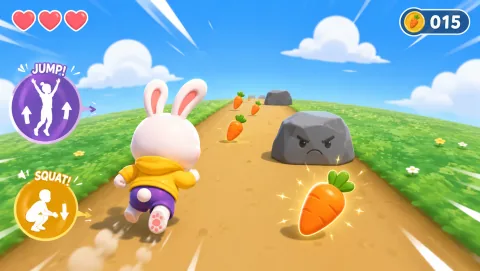
  2. 7 minutes: BunnyHop or FruitSlash — sustained moderate activity, cardiovascular engagement, peak of the session.
  3. 15 minutes: Homework begins while executive function improvements are at their peak. Keep session as close to homework time as possible — ideally within 10 minutes.

Keep it safe

Important notes for parents and caregivers

MovePlay is not a medical treatment for ADHD and should never be used as a replacement for professional diagnosis, medication management, or therapeutic support. Always follow your child's pediatrician and therapist's guidance regarding physical activity recommendations. Supervise movement sessions to ensure the play area is clear and the child remains safe. Stop immediately if the child appears distressed, overwhelmed, or physically uncomfortable. Be aware that high-intensity games immediately before sleep may interfere with sleep onset for some ADHD children — save energetic sessions for earlier in the day.

Common questions

FAQ

Can movement games help children with ADHD?

Research by Hillman et al. (2009) showed that 20 minutes of moderate aerobic exercise significantly improved executive function — including attention, working memory, and inhibitory control — in children with ADHD. Movement games provide this aerobic activity in a format that's highly motivating for ADHD brains due to immediate feedback, varied stimulation, and game reward loops.

How long should sessions be for kids with ADHD?

5–8 minute sessions are ideal for most children with ADHD. Short, complete rounds match the natural attention window for many ADHD children and avoid the frustration that comes from extended sessions. Multiple short sessions throughout the day are more effective than one long session.

Which MovePlay game is best for ADHD?

WhackAMole provides the most immediate feedback loop — moles pop up unpredictably, requiring constant attention and rapid response. This matches the ADHD brain's preference for novel, high-stimulation input and immediate reward. BunnyHop is excellent for releasing high physical energy quickly.

Should I use movement games before or after homework?

Research strongly supports movement before homework for children with ADHD. Hillman et al. (2009) found that aerobic exercise produced measurable improvements in attention and cognitive performance that lasted up to 60 minutes post-exercise. A 10-minute movement game session before homework creates a significantly better cognitive state for academic work.

Move before homework

Channel the energy. Build the focus. Start playing.

Open the game hub