The host is designing a rhythm, not a tournament
The best icebreaker has an invitation, one demonstration, a short round, a visible finish, and a next role. Long queues and complicated scoring make new groups quieter, not more connected.
Social movement games
Use a visible challenge, a short turn, and flexible roles to make a gathering feel active without forcing everyone into the spotlight.
Updated August 30, 2026 · Editorial guide based on the current MovePlay game controls
Best for parties, family reunions, friend groups, remote-team breaks, classrooms, and event hosts who need a fast shared activity.
The best icebreaker has an invitation, one demonstration, a short round, a visible finish, and a next role. Long queues and complicated scoring make new groups quieter, not more connected.
A caller can name targets, a teammate can encourage, and a scorekeeper can track a shared total. People can enter the activity before they enter the camera frame.
Personal bests, team totals, and silly prompts are usually more inclusive than a single winner. Keep the challenge adjustable when people have different movement preferences.
Choose by constraint
These are practical starting points based on each game’s actual control style. Test the camera and room before extending the session.
| Your situation | Start with | Why it fits |
|---|---|---|
| People are meeting for the first time | Awkward Pose Studio | A pose prompt gives observers something concrete to react to and keeps turns short. |
| The group wants light competition | Reaction or Fruit Slash | Use a personal-best or team-total format instead of ranking every person publicly. |
| The room has mixed confidence levels | Bubble Match or Gesture Chess | Offer a quieter role and let people join through strategy, calling, or scorekeeping. |
Practical playbook
Keep the first session small, specific, and easy to stop. The goal is not to create a perfect workout. The goal is to make active play feel like a normal option.
Begin with a single short social icebreaker motion games round to test the real setup: camera position, lighting, and floor space before inviting a group.
Let the first player choose the opening game, then rotate so everyone gets a turn shaping the session.
Track completion, not perfection: one round finished is already a useful data point.
Why it works
The U.S. Surgeon General’s social-connection guidance treats connection as important to individual and community well-being. An icebreaker cannot guarantee connection, but it can reduce the difficulty of starting a shared interaction.
People participate more comfortably when they know how long a turn lasts, what the movement is, and what happens after the score appears.
A group does not need identical skill or intensity. Watching the same target, cheering a teammate, or choosing the next round creates a common focus.
Sources and limits
These links provide background for the guidance above. They do not turn a MovePlay game into a clinical assessment or guarantee a particular health, learning, or relationship outcome.
Start here
These games are browser-based and use body movement through a webcam. No controller or download required.
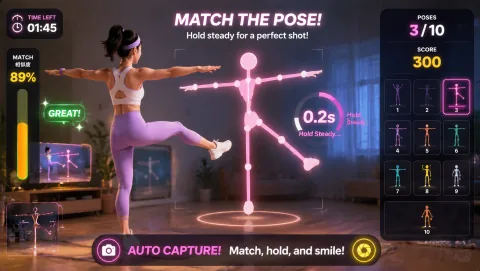
Awkward Pose Studio
Match the tricky body silhouette within 3 seconds and strike a pose for the photo.
02
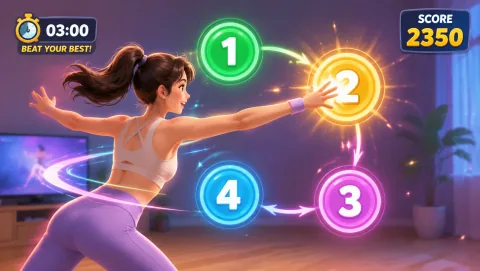 Reaction
4 numbers scatter to the corners — slap them in order with hands and feet. The timer shortens fast; slow reactions cost points.
03
Reaction
4 numbers scatter to the corners — slap them in order with hands and feet. The timer shortens fast; slow reactions cost points.
03
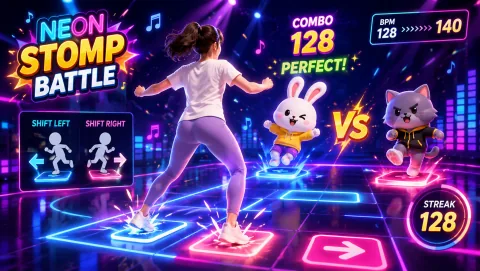 Neon Stomp Battle
Side-step to the beat as BPM ramps up — a lateral stepping and weight-shift rhythm game.
04
Neon Stomp Battle
Side-step to the beat as BPM ramps up — a lateral stepping and weight-shift rhythm game.
04
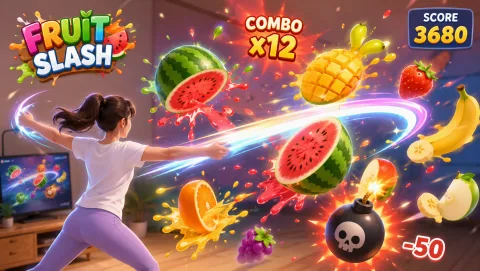 Fruit Slash
Slash fruits with sweeping arms — the moment a bomb appears, pull back instantly.
Fruit Slash
Slash fruits with sweeping arms — the moment a bomb appears, pull back instantly.
Simple routine
Keep the same order every time: invite, demonstrate, play, react, rotate.
More options
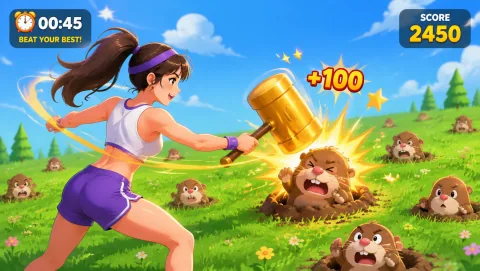 Whack A Mole
Moles pop up — smash them hard. Miss one and the rhythm spirals out of control.
06
Whack A Mole
Moles pop up — smash them hard. Miss one and the rhythm spirals out of control.
06
 Bubble Match
Point both hands at matching bubbles to chain and pop them — rainbow bubbles are wild, bombs clear the area.
07
Bubble Match
Point both hands at matching bubbles to chain and pop them — rainbow bubbles are wild, bombs clear the area.
07
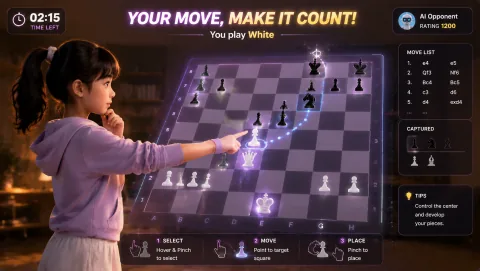 Gesture Chess
Pinch gestures command the pieces — face the AI in a peak showdown and surrender anytime.
Gesture Chess
Pinch gestures command the pieces — face the AI in a peak showdown and surrender anytime.
Keep it realistic
Tell people whether a camera is active, keep recording and sharing opt-in, leave an accessible route around the play zone, and normalize watching or passing. Use smaller movements when the room or group confidence is limited.
Common questions
It needs one easy rule, short turns, a visible finish, and meaningful roles for people who are not currently playing.
Yes. Start with pose, reaction, or target games that observers can understand quickly and keep the round length fixed.
No. A host can run a pass-and-play or shared-screen format. Do not describe it as real-time multiplayer unless the product actually supports that mode.
Offer caller, teammate, scorekeeper, chooser, or observer roles and never make camera participation a condition of belonging.
Move first, scroll later