Webcam games for teens

Webcam games for teens

Reflex battles, score chases, and a genuine skill ceiling — for players who aged out of kids' exercise apps but still want screen time that does something.

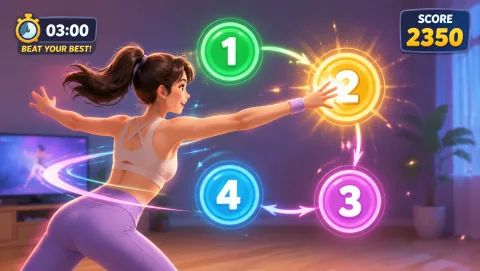
Reaction gameplay preview
Reaction Four numbers scatter to the corners — slap them in order with hands and feet. The timer shortens every round, and slow reactions cost points. There is no participation trophy here.
Best for

Best for teens roughly 13 and up who want competitive, skill-based webcam games — solo personal-best chasing, hot-seat head-to-head with a friend or sibling, or a bracket night with a group — using one laptop and a camera.

01

The Cringe Problem

Most "active games" are built for eight-year-olds: cartoon mascots, star stickers, and applause just for showing up. Once you're past that, the whole category reads as babyish, and you'd rather scroll than be caught playing something with a dancing banana. Fair. The fix isn't to abandon motion games — it's to pick the ones that can actually beat you.

02

A Real Skill Ceiling

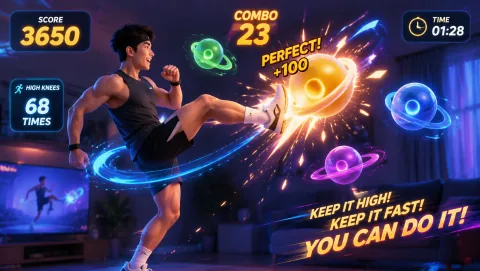
The games worth your time are the ones you can be bad at. Reaction's timer tightens every round. Cyber Knot kills your stream the moment you cut the wrong coil. High Kicks refuses to register lazy half-kicks. You lose because you were slow, not because the game decided your turn was over — which means getting faster is visible, measurable, and entirely on you.

03

Playing, Not Performing

A workout video wants you to follow along and count reps. These games want you to win. Your attention stays locked on targets, timing, and score while the movement happens as a side effect — that's the difference between 15 minutes you endure and 15 minutes you lose track of. If you want motion gaming without a console, that's exactly the gap motion games without a console fill.

Solo formats

Score-chasing that stays interesting

One player, one camera, and the only opponent that matters: your own best run. Three structures that keep solo sessions from going stale.

Versus formats

Head-to-head on one laptop

You don't need two setups for a rivalry. Every competitive format below runs hot-seat: alternate rounds on the same machine and let the scores argue.

Not passive screen time

What you actually get out of it

No inflated promises — these are arcade games, not a training program. But compared with an evening of pure scrolling, the difference is real and you can measure it.

Reflexes respond to practice

Reaction time is a trainable quality, and training it with whole-body movement adds coordination on top of raw speed. Establish a baseline with the free reaction time test, then re-test after a few weeks of score-chasing and compare the numbers.

The movement sneaks up on you

Because your attention sits on the game, the physical volume accumulates quietly: a typical 15-minute Squat Pacman session works out to roughly 80–120 squats. You notice the score chasing, not the reps — until the next morning.

Rounds end, so sessions end

Each game is built from 1–3 minute rounds with a clear finish, not an infinite feed. A best-of-five has a winner and an endpoint. That makes these sessions easier to close than autoplay video — you finish the set and you're done, not three episodes deep.

Slower-burn picks

When you want control over chaos

Want the full set? Browse all free games in the MovePlay game hub, including the cardio collection for the higher-intensity picks.

Ladder night rules

Three rules before the first round

  1. Scores get written down: a whiteboard, a notes app, the back of an envelope — if a PB isn't recorded where everyone can see it, it didn't happen. Verbal claims of "I totally got 900 once" carry no weight.
  2. Winner stays, challenger rotates: in group play, the winner holds the camera and the next challenger steps in. It keeps the queue self-managing and gives everyone a reason to watch rounds they aren't playing.
  3. One game per match, no rematch demands: a match is one agreed game, best of five rounds at most. Instant rematch demands are how a 30-minute bracket becomes a three-hour grudge session.

Room setup

Space and camera notes

Clear a patch of floor about two arm-spans wide and check what's within reach of a full arm swing — lamps, monitors, and siblings all count. Jump and kick games need headroom, so skip them under low ceilings or ceiling fans. Wear shoes or play barefoot, not socks on hard floors. The camera only needs to see your upper body and arms for most games; full-body picks like Bunny Hop want you a step or two further back so your feet stay in frame.

Common questions

FAQ

Aren't webcam games just for little kids?

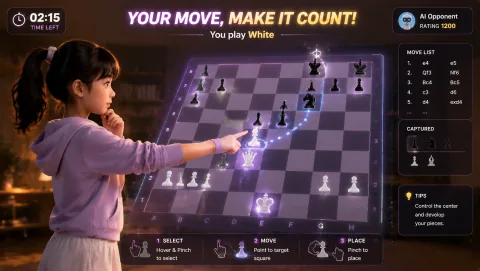
Most of the genre is — mascot characters, sticker rewards, applause for showing up. The exception is games with a real fail state. On MovePlay, Reaction's timer shortens every round, Cyber Knot's data stream explodes the moment you cut the wrong coil, and High Kicks refuses to register half-hearted kicks. Gesture Chess is full chess against an AI. If a game can beat you, it wasn't built for toddlers.

Can you play competitively with only one webcam?

Yes — hot-seat. Both players run the same game in alternating rounds and compare scores, best of five. Reflex games with 60-to-90-second rounds (Reaction, Whack a Mole, Fruit Slash) rotate fast enough that nobody waits long. With four or more people, run a single-elimination bracket and keep every match to one short game so the whole bracket finishes in under half an hour.

Do these games count as real exercise?

They're light-to-moderate activity, not a training program. A 15-minute Squat Pacman session works out to roughly 80–120 squats, and cardio picks like High Kicks and Bunny Hop raise your heart rate — that's a genuine step up from scrolling on the couch, but it doesn't replace sport, the gym, or a run. Think of it as screen time that isn't passive.

How do I know if my reflexes are actually improving?

Two ways. First, log your scores: pick two or three games, write down your best run each week, and watch the trend over a month — scores that keep climbing mean your response speed is climbing with them. Second, take the free reaction time test on MovePlay's tools page for a stopwatch-style number you can re-test later and compare directly.

Do I need to download anything or make an account?

No. Every MovePlay game runs in the browser with a webcam — no download, no signup, no console, and all games are free. Open the game page, allow camera access, and you're playing. The camera feed is processed on your device for tracking your movement; there's no account to create and nothing to install.

MovePlay — Free Webcam Motion Games

Your high score isn't going to beat itself.

Play Reaction free