Standing desk fitness

Standing desk workout games that use the space you already have

Standing is a start. These games turn your standing desk time into genuine movement — squats, side-steps, arm swings — through browser-based motion gaming with no equipment.

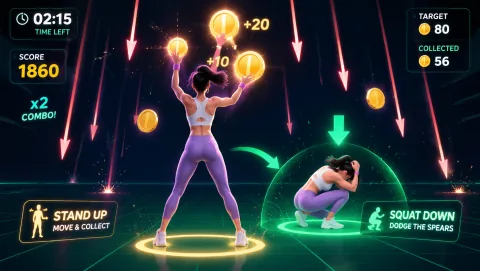
Squat Pacman gameplay preview
Squat Pacman Squat to dodge, stand to catch gold coins — your vertical position is the controller.
Best for

Standing desk users who want to convert passive standing time into structured movement — and get more benefit from an investment they've already made.

01

Add Micro-Squats

SquatPacman turns every squat into a game action. Rather than counting reps — which nobody does at a desk — you squat to survive and stand to score. Your quads and glutes get real work without needing a gym or a timer. Three minutes of this approach engages more lower-body muscle than 30 minutes of passive standing.

02

Side Steps During Breaks

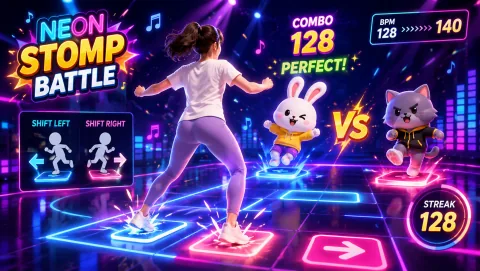
NeonStompBattle is designed around lateral footwork synced to a rising BPM. Even small side-steps at a standing desk change your hip position and break up continuous sitting — passive standing leave entirely dormant. A 5-minute round of NeonStompBattle significantly outperforms just standing still.

03

Arm Movements Equal Shoulder Health

Remote workers with standing desks still tend to hold arms in a fixed typing position. GenkiRun and BunnyHop require full arm swings and overhead reaches, mobilizing the thoracic spine and shoulders in directions that desk work never touches. Think of it as a standing desk upgrade: from static to dynamic.

Practical playbook

How to make standing desk workouts work

A standing desk is a great base. The gains multiply when you turn the desk transition into a movement trigger — every time the desk rises, it signals a game round. That pairing builds the habit faster than intention alone.

Why it works

Standing desks are better with movement — here's the evidence

Standing burns 50% more calories than sitting

A study by Finni et al. (2014) using electromyography confirmed that standing engages significantly more muscle tissue than sitting, burning approximately 50% more calories per hour. However, this baseline benefit is far exceeded when standing is combined with light physical activity — the combination of standing and movement can burn 3–4 times the calories of seated sedentary time.

Light activity improves metabolic markers

Thorp et al. (2014) published research in Diabetes Care showing that light-intensity physical activity — including simple stepping and standing with movement — produces meaningful improvements in blood glucose, insulin sensitivity, and triglyceride levels. These benefits were absent in workers who stood passively without moving their lower bodies.

Standing desk plus movement outperforms either alone

Multiple workplace intervention studies have confirmed what physiology predicts: a standing desk alone is a modest improvement, but pairing it with short bouts of rhythmic movement produces significantly larger reductions in sedentary behavior risk. Workers in combined standing-plus-movement programs report higher afternoon energy levels and better focus than standing-only groups.

Simple routine

A 15-minute standing desk workout

  1. 3 minutes: SquatPacman — lower body warm-up, controlled squats, let the game pace you.
  2. 7 minutes: NeonStompBattle — lateral movement, rhythm, elevated heart rate.
  3. 5 minutes: GenkiRun — arm swings and full-body coordination to close the session.

Keep it safe

Safety notes for standing desk workouts

Ensure your standing mat is non-slip and your screen is at eye level before playing. Avoid deep squats if you have knee pain — SquatPacman responds to partial range of motion. Stay within your webcam's field of view by standing 1.5–2 metres from the camera. Stop if you feel balance instability, joint pain, or dizziness. Wear supportive shoes — standing desk games work best without socks on hard floors.

Common questions

FAQ

What's the best MovePlay game for a standing desk?

SquatPacman is ideal — it directly rewards squatting to dodge and standing to collect coins, turning your body position into the game mechanic. NeonStompBattle is excellent for side-stepping and lower body engagement at a standing desk.

Can I do squats while playing MovePlay games?

Yes. SquatPacman is built around squatting as a core mechanic. GenkiRun and BunnyHop also reward lower-body movement. You can integrate bodyweight squats, calf raises, or lateral steps into most games since the webcam tracks your whole body.

How long should standing desk sessions be?

Research suggests alternating between sitting and standing every 30–60 minutes. A 10-minute active movement session at your standing desk — combining a game round with light exercise — is a practical and evidence-backed approach.

Does standing alone burn enough calories to matter?

Standing burns approximately 50% more calories than sitting (Finni et al., 2014), but the biggest metabolic gains come from adding movement to standing time. Light exercise like mini-squats, side steps, and arm swings during game play multiplies the caloric benefit significantly.
Your desk is ready

Turn your next standing session into an active one.

Open the game hub