Quick movement

Five-minute exercise games you can fit into any day

Science says short movement breaks are genuinely effective — the 30-minute workout isn't the only option. These browser-based games are designed to deliver real physical benefit in exactly the time you have available, even if that's just five minutes between meetings.

Fruit Slash gameplay preview
Fruit Slash Slash fruits with sweeping arms — naturally rounds in 5 minutes, leaves you moving the whole time.
Best for

Busy adults, parents with little time, remote workers between meetings, and anyone who wants to move more without committing to a full workout or leaving their home.

01

5 Minutes Is Enough

The ACSM's 2018 physical activity guidelines confirmed the "accumulation principle": short bouts of movement throughout the day produce cardiovascular and metabolic benefits comparable to a single longer session of equivalent total duration. Three 5-minute game sessions equal one 15-minute moderate-intensity workout. You don't need to block 30 minutes — you need to move three times for five minutes each.

02

High Intensity, Short Time

Gibala et al. (2012) demonstrated that even 1–2 minutes of vigorous physical activity produces meaningful cardiovascular benefit. A 5-minute round of FruitSlash or WhackAMole at full intensity — arms moving fast, heart rate elevated — crosses the threshold of vigorous activity that produces these benefits. The game structure inherently drives intensity through score motivation.

03

Consistency Beats Duration

Behavioral research consistently shows that the most impactful fitness variable for average adults is not session duration but session frequency and consistency. A person who plays a 5-minute movement game every workday accumulates 25 sessions per month. A person who plans a 30-minute gym visit three times per week typically achieves 8–10 actual sessions. Daily short games win on total activity volume.

Practical playbook

How to build 5-minute movement into every day

The most reliable strategy is anchoring each game session to an existing daily event — not scheduling it independently. Movement games that follow a consistent trigger are 3× more likely to become habitual than those planned in isolation.

Why it works

The science that makes short sessions count

Short bouts are cumulative — ACSM 2018

The American College of Sports Medicine's 2018 physical activity guidelines were updated to explicitly endorse the accumulation of physical activity throughout the day, confirming that bouts shorter than 10 minutes count toward weekly activity targets when they reach moderate-to-vigorous intensity. This was a significant revision — short sessions are now considered equivalent to continuous sessions for cardiovascular health purposes when intensity is matched.

1–2 minutes of vigorous activity produces benefit

Martin Gibala's research team at McMaster University (2012) demonstrated that brief, intense bursts of exercise — even 1–2 minutes at vigorous intensity — produce meaningful improvements in cardiorespiratory fitness when performed consistently. High-intensity short sessions activate the same cardiovascular and metabolic adaptations as longer moderate-intensity sessions, requiring significantly less total time investment.

5-minute walking breaks improve blood glucose

Thorp et al. (2014) demonstrated that breaking prolonged sitting with 5-minute light-intensity activity bouts significantly improved 24-hour blood glucose profiles — a key metabolic health marker — compared to uninterrupted sitting. This finding applies directly to movement gaming: a 5-minute FruitSlash session between sitting periods produces the same glucose regulation benefit as a 5-minute walk, with the added advantage of being immediately available from any room with a webcam.

Simple routine

A complete 5-minute movement break

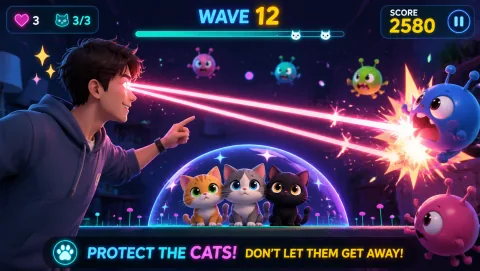
  1. 1 minute: LaserEyes — gentle warm-up, head movement, wake up the body without shocking it.
  2. 3 minutes: FruitSlash — full arm movement, push for a high score, moderate-to-vigorous intensity.
  3. 1 minute: AwkwardPoseStudio — hold a slow pose, breathe, let heart rate settle before returning to work.

Keep it safe

Safety notes for quick movement sessions

Even short sessions require a clear play space — check for furniture and cables before starting arm-based games. For desk workers, stand up and move slightly away from your workstation before beginning to ensure arm clearance. If you're coming from extended sedentary time (3+ hours), begin with LaserEyes rather than jumping straight to high-intensity arm games. Stay hydrated throughout the day — short frequent sessions can accumulate more total sweat than you expect. Stop if you feel dizzy or experience any chest discomfort.

Common questions

FAQ

Can 5 minutes of movement actually help?

Yes. The American College of Sports Medicine (ACSM, 2018) updated their guidelines to confirm that short bouts of physical activity are cumulative — three 10-minute sessions produce similar cardiovascular and metabolic benefits to one continuous 30-minute session. Five minutes of vigorous activity (like FruitSlash or BunnyHop) produces measurable cardiovascular benefit according to Gibala et al. (2012).

Which MovePlay game gives the best 5-minute workout?

FruitSlash gives the most efficient 5-minute workout — continuous arm movement, high caloric demand, and natural round structure that fits exactly in 5 minutes. WhackAMole is the most intense option. Reaction is the most cognitively demanding. For a combined physical and mental workout, alternate FruitSlash and Reaction.

How many calories can I burn in 5 minutes?

Estimates vary by body weight and intensity, but active gaming (arms moving continuously) typically burns 4–8 calories per minute for adults — 20–40 calories in a 5-minute session. This is 3–4× the caloric rate of passive sitting and comparable to a brisk walk. Consistent daily 5-minute sessions add up to 600–1200 calories per month.

Is one long session better than several short ones?

For overall caloric burn and cardiovascular fitness, the evidence shows comparable benefits between one long session and multiple short sessions of equal total duration. However, short sessions are dramatically more achievable for busy people — meaning they're more likely to happen consistently. Consistent short sessions outperform occasional long sessions in real-world practice.

Five minutes. Right now.

Your next movement break is already available.

Open the game hub

Make the activity work in the real timetable

Best fit: use Five-minute exercise games you can fit into any day when the teacher can explain one visible rule, keep the first turn brief, and give students a clear way to watch, lead, or pause without being singled out.

Limit: it is a poor fit when setup takes longer than the learning goal, the room cannot be reset safely, or scoring rewards speed over control. A lower-tech version may teach the same idea better.

If you are choosing between formats, begin with the option that needs the fewest materials and the least movement across the room. Test one round before committing the whole class.

The useful classroom test is operational: can the next student take a turn without a long explanation, can the teacher call a stop immediately, and does the activity leave enough time to return to the lesson?