Science movement games

Science movement games

Movement ideas built for science class: animal-locomotion imitation, states-of-matter movement calls you can assess at a glance, and short webcam game breaks that reset a room mid-block — one teacher laptop, no student devices.

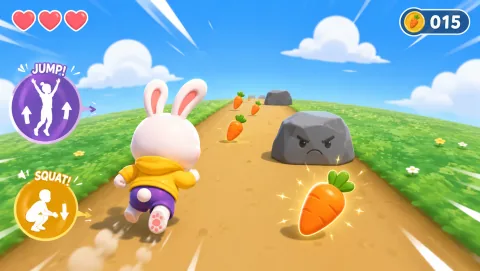
Bunny Hop gameplay preview
Bunny Hop Dodge left and right, duck under barriers, and leap over gaps. The closest thing on the site to an animal-locomotion drill — hop, duck, and sidestep your way down an endless course.
Best for

Best for elementary and middle school science teachers who want movement woven into the block itself — warm-up calls tied to the unit, active breaks between lab steps, and calm hand games while results get recorded.

01

Animal Locomotion Imitation

Before or after a lesson on adaptations, have students move the way the animals they're studying move: sideways like a crab, hopping like a frog, low and gliding like a snake, waddling like a penguin. Call the animal, give 20 seconds of movement, then freeze. The physical memory of "crab = sideways" sticks better than a labeled diagram, and the freeze signal keeps it from turning into a zoo.

02

States-of-Matter Movement Calls

Solid, liquid, and gas each get a body shape: tight frozen curl, loose flowing sway, light scattered bounces. Call a state — or a change of state like "condensation!" — and students shift shapes in slow motion. It works as a warm-up, a mid-block reset, or an exit ticket you can read from the front of the room: the two students still bouncing during "freezing" are the ones to check in with.

03

Active Breaks Between Lab Steps

Science blocks have natural seams — after setup, while a reaction runs, before data discussion. Those seams are where fidgeting and off-task drifting start. A 2-minute projected webcam game at the seam burns the restlessness off on purpose, in a controlled format, instead of letting it leak into the next instruction.

Teacher-led movement calls

Movement calls that double as review

These need no devices at all — just your voice and a class that knows the shapes. Run any of them as a 3-minute warm-up or a quick check for understanding.

Webcam games in the block

Where the games actually fit

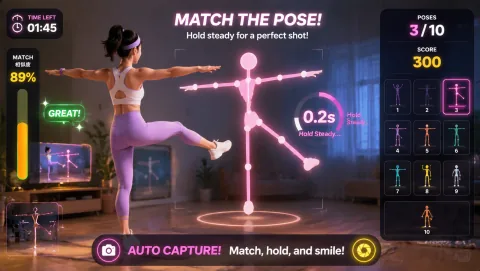
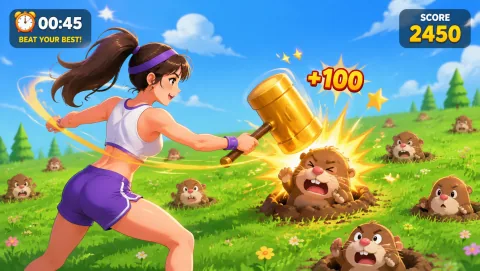
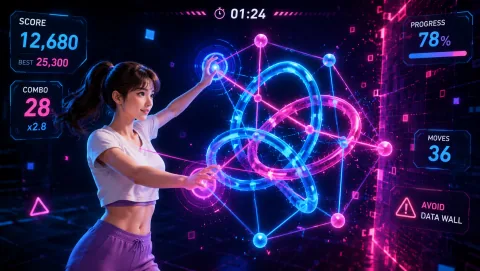
MovePlay's games are reflex and fitness games, not science lessons — treat them as the active break, and let your own calls carry the content. Three placements work well in a science block.

Honest framing

Movement supports focus — it isn't the lesson

It's tempting to call every active game "educational." Resist it in your planning: the games below train reaction speed, coordination, and stamina. The science learning comes from your prompts, your discussion, and your lab. What movement reliably does is give restless students a legitimate outlet so they can re-engage with the next task.

Break, not curriculum

Use games at transitions and waits, not as a substitute for the activity they surround. A 2-minute Bunny Hop round between lab steps supports the lesson; a 20-minute session replacing it doesn't.

Attach your own prompts

The review value comes from your calls: states of matter, life cycles, classifications. Games don't need science skins to be useful — they need a science teacher who knows exactly when to start and stop them.

Match tempo to what's next

Heading into data recording? End on a slow hand game like Bubble Match. Heading into a demo? A quick reflex round is fine. The game's tempo sets the room's tempo for the next five minutes — pick accordingly.

Calm picks for data time

Wind down into bench work

Browse all free games in the MovePlay game hub, check whether your classroom computer can run them with the compatibility test, or see more subject-agnostic picks in the Classroom Movement Games That Get Students Active guide.

A ready-to-run structure

One science block, three movement moments

  1. Minutes 0–3, warm-up call: open with 90 seconds of states-of-matter or life-cycle calls tied to today's unit. It settles arrivals, surfaces misconceptions you can address later, and costs almost no lesson time.
  2. Mid-block seam, game break: at the first natural wait — reaction running, setup done, discussion not started — run one 2-minute projected round. One student on camera, class mirroring at stations, posted turn order so there's no negotiation.
  3. Final 5 minutes, calm close: cleanup, then a seated-friendly hand game while early finishers wait, ending with everyone recording results. The class leaves the block having moved three times without the lesson ever stopping for "PE."

Lab-aware setup

Space and camera notes for science rooms

Movement comes after glassware and chemicals are back in their trays, not before — make "benches clear" the price of the game starting. Tape a camera spot on open floor about two arm-spans wide, away from bench corners and sinks. Students mirroring at stations push stools in and keep an arm's length from neighbors and equipment. Skip jumping games on days the room layout leaves no safe floor patch — hand and head games like Bubble Match, Snake, and Laser Eyes cover those days from a stool-sized footprint.

Questions science teachers ask

FAQ

Do webcam movement games teach science content?

No — and it's better to plan that way. MovePlay games are reflex, coordination, and fitness games; they don't explain photosynthesis or the water cycle. What they do well is give students a short, structured physical reset between science activities, so the class comes back to the next task with energy spent and hands ready. The science review comes from your own prompts — vocabulary calls, classification sorts, sequencing — with movement as the delivery vehicle.

How do states-of-matter movement calls work?

Assign each state a body shape before you start: solid is a tight frozen curl, liquid is a slow flowing sway with loose arms, gas is light bounces spread across your spot. Call a state and students snap into its shape; call a change like "melting!" and they transition in slow motion from solid to liquid. You can read the whole room's understanding in two seconds — anyone frozen during "evaporation" needs a follow-up question.

What works in a science lab with almost no open floor?

Skip the jumping and kicking games and use hand- and head-controlled titles at a cleared station: Snake steers with palm position, Laser Eyes aims with small head turns, and Bubble Match uses one-hand pointing. All three run from a stool-sized footprint. Keep animal imitation and states-of-matter calls for the front of the room or the hallway, where desks and glassware aren't in elbow range.

Can one teacher laptop run a whole science class?

Yes. Connect the laptop to the projector or smartboard, point its camera at a taped-off floor spot, and rotate one student scientist onto camera per round while the rest of the class mirrors the movements from their lab stations. No student devices, accounts, or downloads are involved — the games run in the browser.

How long should a movement break be inside a science block?

Two to four minutes is the sweet spot for a 45–60 minute block: long enough to burn off fidgets, short enough that the half-finished experiment still pulls students back. Place the break at a natural seam — after setup, before data discussion, or while one group's results finish — and end on a calm hand game so the class lands back at bench-work energy rather than recess energy.
MovePlay — Free Webcam Motion Games

Next time the reaction needs two minutes, give the class somewhere to put the energy.

Play Bunny Hop free