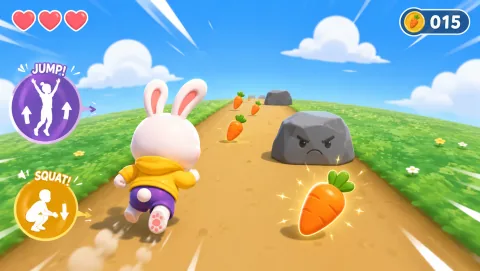
Reading movement games

Reading movement games for kids

Reading practice goes better in blocks: read a little, move a little, read again. Webcam games give young readers a two-minute physical reset between pages — plus pose play and sight-word movement that plug straight into the story.

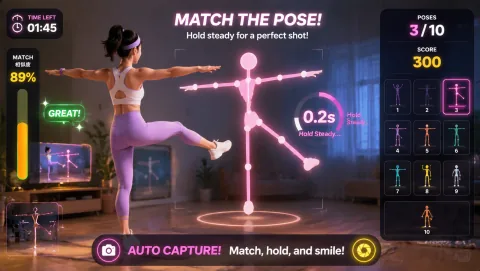
Awkward Pose Studio gameplay preview
Awkward Pose Studio A silhouette appears on screen — match the pose within 3 seconds. Pause the story at a dramatic moment and have your reader freeze as the character, then match a round of poses before reading on.
Best for

Best for parents, tutors, and homeschool families working with early and elementary readers (roughly ages 4–9) who lose focus or fidget through longer reading sessions — one laptop near the reading spot is the whole setup.

01

Read–Move–Read Blocks

Long reading sessions fail early readers at the ten-minute mark, not the one-hour mark. Split practice into short blocks: read for 5–10 minutes, play a single round of a webcam game, then return to the page. The movement break clears the fidgets out physically instead of letting them leak into the reading, and the fixed round length means the break can't quietly take over the session.

02

Act Out the Story

Stories are full of movement waiting to be borrowed. Pause at a tense moment and have your child freeze in the hero's pose, stomp like the giant, or creep like the cat sneaking through the garden. Pose-matching games pair naturally with this: match the silhouette as the character, then read on to find out what happens next. Retelling the plot through movement doubles as a comprehension check that doesn't feel like a quiz.

03

Sight Words on Their Feet

Sight-word drills go down easier standing up. Write the week's words on sticky notes around the room and attach a movement to each one — jump for "said," squat for "the," spin for "was." Call a word, your child finds it and does its move. The game rounds between drills keep the energy up; the words stay the point. This pairs the physical reset with rehearsal your child was going to do anyway.

Between reading blocks

Breaks that send kids back to the page

The movement break only works if the reading resumes. Three structures that keep the break short, predictable, and pointed back at the book.

Story-linked play

Movement pulled from the book

These need no extra materials — just the book you're already reading and a cleared patch of floor. Use one per reading session, at the natural pause points.

Honest framing

What movement does — and doesn't — do for reading

Movement breaks support reading practice; they don't replace it. Keeping that line clear is what makes the routine sustainable instead of gimmicky.

Movement resets attention

A couple of minutes of physical activity between reading blocks gives a fidgeting reader somewhere to put the restlessness, so the next block starts calmer. That's the honest claim: the games help kids sit back down ready to read. The reading itself is still what builds the skill.

These are movement games, not reading software

MovePlay games train reflexes, coordination, and timing — none of them teach phonics, vocabulary, or comprehension. If a child is struggling with reading itself, that's a job for instruction and, where needed, a specialist — not a problem a webcam game can fix.

The book stays the main event

A useful gut-check: your child should spend more minutes with the text than with the game, every session. If the ratio flips, shorten the breaks or drop to one per session. Movement is the punctuation between reading blocks, not the sentence.

Back-to-the-book picks

Wind down before the next page

Want more? Browse all free games in the MovePlay game hub, check the webcam games overview, or see the MovePlay for parents page for home setup tips.

A sample session

The 25-minute reading session, built to hold attention

  1. Minutes 0–8 — Read: open with the easiest material first (a familiar picture book or a re-read) so the session starts with a win. Stop at a natural pause — end of a page spread or a chapter beat — not mid-sentence.
  2. Minutes 8–11 — Move: one round of your bookmark game, announced in advance. If the round was high-energy, close with 30 seconds of a slow game or a shared sentence read aloud standing up.
  3. Minutes 11–20 — Read again: the second block carries the harder material — new vocabulary, longer stretches of text — because attention is at its best right after the reset. End this block with a plot-point retell in motion.
  4. Minutes 20–25 — Close calm: finish with sight-word movement or one quiet game round, then preview what you'll read next time. Ending on a calm note makes tomorrow's session easier to start.

Reading-nook setup

Space and camera notes

Set the laptop at the edge of the reading spot, camera pointed at a clear patch of rug about one armspan wide — the child shouldn't have to relocate away from the book to play. Move the bookshelf corner and coffee table out of kicking range before jumping games, and on days when the space is cramped, stick to hand and pose games; they need no floor space at all. Keep rounds to the one-round rule, and let your child hold the book during setup so the session never fully lets go of the story.

Questions parents ask

FAQ

Do movement games teach kids to read?

No. MovePlay games are reflex and movement games — they don't teach phonics, vocabulary, or any reading skill, and they aren't a substitute for reading instruction or tutoring. What they do well is give a restless reader a physical reset between practice blocks, so the next block starts with a settled body and a fresher attention span. The reading progress comes from the reading; the movement just makes sitting down for it easier.

How long should a movement break be during reading practice?

Two to three minutes is the sweet spot for early readers. Younger children (ages 4–6) do well with a short break after every 5–8 minutes of reading; older kids (7–9) can often read 10–15 minutes before needing one. A break longer than about 4 minutes starts to feel like playtime instead of a pause, and getting back to the book becomes a negotiation instead of a routine.

What if my child won't go back to the book after the game?

End every break with a calm, slow game rather than a high-energy one — a quiet hand puzzle or matching round brings the tempo down so the transition to the page isn't a crash. Also make the book the thing that's already open and waiting when the game closes, and keep the number of rounds fixed and announced up front: "two rounds, then back to chapter three." Kids return more willingly when the end of the break is predictable.

Which games work in a small living room next to the reading spot?

Hand-tracking and pose games need the least space — a clear patch the width of the child's armspan is enough for pose-matching, bubble-matching, and palm-guided games. Save the jumping and side-stepping games for rooms with open floor, or swap them out entirely on days when space is tight. The webcam only needs to see the player, so a laptop on the coffee table pointed at a cleared rug works fine.

Can I tie the movement to what my child is actually reading?

Yes, and it's the most engaging version of this routine. Pause at a dramatic moment in the story and have your child freeze in the character's pose, act out how the setting would feel to move through, or do a motion for each story event they can retell in order. You're not adding a lesson on top of the game — you're using the break to check comprehension through movement, then diving back into the text.
MovePlay — Free Webcam Motion Games

Next reading block, end the page with a pose.

Play Awkward Pose Studio free