Connection is built in the transition
The most valuable part may be the invitation and the conversation after a round, not the score. Put phones aside, name the time boundary, and let one person choose the first game.
Family connection through play
A practical play format for families who want more shared attention, fewer setup arguments, and a game everyone can enter at a different pace.
Updated August 30, 2026 · Editorial guide based on the current MovePlay game controls
Best for after-school time, rainy afternoons, family game night, sibling play, and visits with mixed ages.
The most valuable part may be the invitation and the conversation after a round, not the score. Put phones aside, name the time boundary, and let one person choose the first game.
A child can demonstrate, a parent can host, a sibling can call targets, and a grandparent can choose the next round. Shared play should not require identical movement or speed.
A game can create a shared moment; it cannot guarantee a repaired relationship. If a family is dealing with serious conflict or distress, play should sit alongside appropriate support rather than replace it.
Choose by constraint
These are practical starting points based on each game’s actual control style. Test the camera and room before extending the session.
| Your situation | Start with | Why it fits |
|---|---|---|
| A younger child wants to lead | Awkward Pose Studio or Bubble Match | Let the child choose prompts or colors while the adult manages time and space. |
| A grandparent or sibling needs a slower role | Gesture Chess or Whack A Mole | Use strategy, reaching, or short turns and keep a caller or teammate nearby. |
| The family has different energy levels | Reaction plus a hand-led alternative | Keep the same shared theme while letting each person select their movement range. |
Practical playbook
Keep the first session small, specific, and easy to stop. The goal is not to create a perfect workout. The goal is to make active play feel like a normal option.
Make it a family score challenge where everyone gets one attempt and the best improvement wins.
Let younger kids pick the game theme while adults keep the session short and safe.
Track completion, not perfection: one round finished is already a useful data point.
Why it works
Recent parent-child activity research describes co-produced play resources as a way to support engagement and social-emotional development. That supports offering a structured shared activity, not claiming a guaranteed family outcome.
A repeatable ten-minute invitation is easier to trust than a new activity that takes half an hour to explain. Keep the opening and closing predictable.
Different ages can share a theme while using different posture, pace, turn length, or observer roles.
Sources and limits
These links provide background for the guidance above. They do not turn a MovePlay game into a clinical assessment or guarantee a particular health, learning, or relationship outcome.
Start here
These games are browser-based and use body movement through a webcam. No controller or download required.
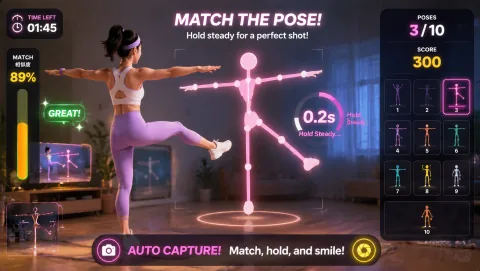
Awkward Pose Studio
Match the tricky body silhouette within 3 seconds and strike a pose for the photo.
02
 Bubble Match
Point both hands at matching bubbles to chain and pop them — rainbow bubbles are wild, bombs clear the area.
03
Bubble Match
Point both hands at matching bubbles to chain and pop them — rainbow bubbles are wild, bombs clear the area.
03
 Whack A Mole
Moles pop up — smash them hard. Miss one and the rhythm spirals out of control.
04
Whack A Mole
Moles pop up — smash them hard. Miss one and the rhythm spirals out of control.
04
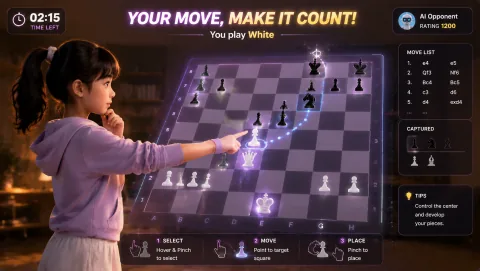 Gesture Chess
Pinch gestures command the pieces — face the AI in a peak showdown and surrender anytime.
Gesture Chess
Pinch gestures command the pieces — face the AI in a peak showdown and surrender anytime.
Simple routine
Keep the phone-free invitation short and leave enough time to talk after the final round.
More options
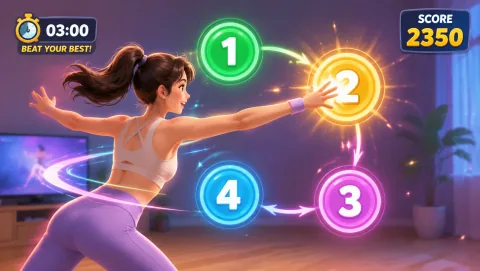 Reaction
4 numbers scatter to the corners — slap them in order with hands and feet. The timer shortens fast; slow reactions cost points.
06
Reaction
4 numbers scatter to the corners — slap them in order with hands and feet. The timer shortens fast; slow reactions cost points.
06
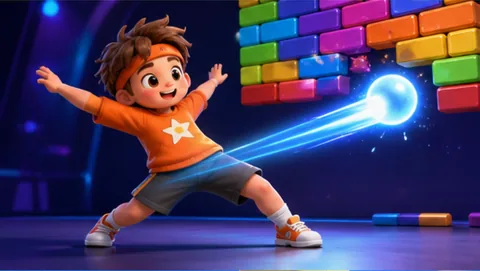 Paddle Guard
Move your body as the paddle, bounce the ball and smash all the bricks!
07
Paddle Guard
Move your body as the paddle, bounce the ball and smash all the bricks!
07
 Fruit Slash
Slash fruits with sweeping arms — the moment a bomb appears, pull back instantly.
Fruit Slash
Slash fruits with sweeping arms — the moment a bomb appears, pull back instantly.
Keep it realistic
Adults should set the space and camera boundary, keep the frame private, and avoid turning a child’s score or body into a public comparison. Choose a lower-movement option when needed and stop for pain, dizziness, or discomfort.
Common questions
Start with a game that gives both people a clear role, such as pose prompts, target matching, or a hand-led strategy turn.
Use fixed turns, a shared team score, and a chooser or caller role for the sibling waiting. Change the role before changing the child.
Often, yes, when the family chooses simple rules and flexible intensity. A seated, hand-led, caller, or scorekeeper role is a valid way to participate.
It may create one shared moment, but it is not therapy or a guaranteed repair method. Use qualified support when the situation calls for it.
Move first, scroll later