Audience
The practical question is how to give casual attendance a repeatable activity format when people join late, leave early, and may not share conversation topics.
Give distributed teams a shared active pause
A good remote lunch-club games moment should be easy to understand from the side of the room. The host’s job is to make joining, watching, and stopping equally ordinary.
Webcam input fits equipment many remote workers already use. Hand-tracking and upper-body games provide compact options, while larger-space games can remain available for volunteers with room to move.
For employee community hosts, this is a remote lunch-club games decision inside an online lunch club. The pressure is concrete: people join late, leave early, and may not share conversation topics.
In the online lunch club, the meeting facilitator starts with GestureChess because people join late, leave early, and may not share conversation topics. The host demonstrates hand pointing and pinch selection, runs one bounded turn, and hands the station to the next participant so the program can give casual attendance a repeatable activity format. The practical question is how to give casual attendance a repeatable activity format when people join late, leave early, and may not share conversation topics.
The practical question is how to give casual attendance a repeatable activity format when people join late, leave early, and may not share conversation topics.
Start with the smallest workable footprint: Use a personal camera zone that each participant can check against local furniture and coworkers.
The activity earns a second round by fitting the room, not by demanding more of it. For employee community hosts, also provide spectator, scorekeeper, and no-camera roles.
If people join late, leave early, and may not share conversation topics, use this exit: At the online lunch club, if people join late, leave early, and may not share conversation topics, use a verbal or chat-based prompt for anyone without a workable camera zone; otherwise move from GestureChess to QuickHands without expanding the marked footprint.
For an online lunch club, readability beats spectacle. Begin with a cue people can see, a marked footprint, and a turn that ends before the next handoff becomes awkward.
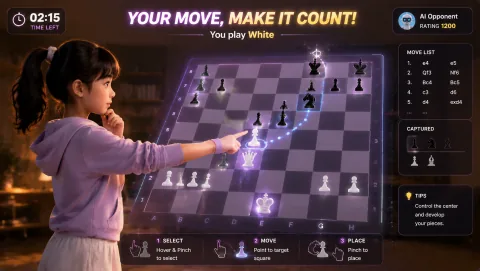
hand pointing and pinch selection
GestureChess leads because hand pointing and pinch selection supports the specific goal to give casual attendance a repeatable activity format. Use a personal camera zone that each participant can check against local furniture and coworkers.
Practical fit: calm, self-paced sessions where strategy matters more than speed. Plan for seated or compact standing space with low movement.

hand direction matching with occasional squat cues
QuickHands changes the route through hand direction matching with occasional squat cues. For Employee community hosts in the online lunch club, offer GestureChess first to anyone choosing a lower-movement or seated role: its hand pointing and pinch selection uses seated or compact standing space with low movement. Also provide spectator, scorekeeper, and no-camera roles.
Practical fit: short reaction rounds where hand cues keep the interaction legible. Plan for compact full-body space with adjustable movement.
Two later options: Reaction brings whole-body movement toward visual targets, while BubbleMatch brings two-hand pointing and color matching. Test both against the real pressure that people join late, leave early, and may not share conversation topics.
Rehearse Gesture Chess before this moment. The best rehearsal question is simple: can a host demonstrate Gesture Chess, finish the turn, and explain the next role in one breath?
Open Gesture ChessKeep a second route ready. If people join late, leave early, and may not share conversation topics makes the first choice awkward, use the hub to compare a quieter, smaller-footprint, or more social opening for an online lunch club.
Browse the full game hub01
For this exact online lunch club, protect agenda cues, remote turn-taking, local room differences, and optional participation; GestureChess is first because its profile uses seated or compact standing space with low movement.
02
The host demonstrates hand pointing and pinch selection, runs one bounded turn, and hands the station to the next participant so the program can give casual attendance a repeatable activity format.
03
For the online lunch club, the meeting facilitator checks the camera mark, explains GestureChess's hand pointing and pinch selection, invites one voluntary turn, resets the result, and offers QuickHands only while the flow remains clear enough to give casual attendance a repeatable activity format.
04
At the online lunch club, if people join late, leave early, and may not share conversation topics, use a verbal or chat-based prompt for anyone without a workable camera zone; otherwise move from GestureChess to QuickHands without expanding the marked footprint.
First-rehearsal standard: The format can give casual attendance a repeatable activity format without interfering with the main purpose of an online lunch club.
For Employee community hosts in the online lunch club, offer GestureChess first to anyone choosing a lower-movement or seated role: its hand pointing and pinch selection uses seated or compact standing space with low movement. Also provide spectator, scorekeeper, and no-camera roles.
Do not record, screenshot, or score individual feeds without workplace consent. Before the first GestureChess turn in the online lunch club, state that choice and keep opt-out participation available for employee community hosts.
At the online lunch club, if people join late, leave early, and may not share conversation topics, use a verbal or chat-based prompt for anyone without a workable camera zone; otherwise move from GestureChess to QuickHands without expanding the marked footprint.
Try Gesture Chess and time one complete cycle for employee community hosts. Check framing, legibility, choice, and how quickly the room can return to its main purpose.
Remote Lunch-Club Games may benefit from a broader game rotation. Compare current plan details for broader catalog access; do not assume commercial-use rights, custom branding, event licensing, or any other plan entitlement that is not explicitly listed.
Compare current MovePlay plansIn the online lunch club, the meeting facilitator starts with GestureChess because people join late, leave early, and may not share conversation topics.
Use a personal camera zone that each participant can check against local furniture and coworkers. Do not record, screenshot, or score individual feeds without workplace consent.
At the online lunch club, if people join late, leave early, and may not share conversation topics, use a verbal or chat-based prompt for anyone without a workable camera zone; otherwise move from GestureChess to QuickHands without expanding the marked footprint.