Camp counselor playbook

Indoor games for summer camp

Movement games for groups of 8–30 campers when rain, a heat wave, or an air-quality alert kills the outdoor schedule. One laptop and a projector is enough.

Neon Stomp Battle gameplay preview
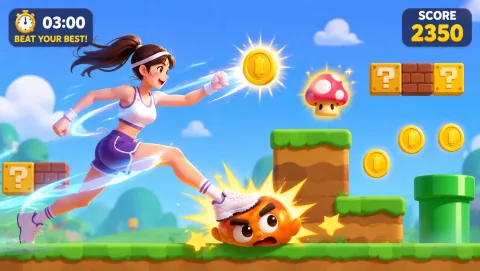
Neon Stomp Battle Campers stomp and side-step to the beat as the tempo ramps up. Run it as a team relay: one camper per round, whole cabin cheering from the sides.
Best for

Day camps and overnight camps with 8–30 kids per group, mixed ages 5–13, a rec hall or gym, and one screen — or no screen at all.

01

Team Tournaments Beat Free Play

With 20 kids and one screen, open turns collapse into arguing over who goes next. Split the group into cabins or color teams of four or five, and score every round toward a team total. Cabin-vs-cabin scoring keeps the kids waiting for their turn locked in, because every round — not just their own — moves their team's number.

02

Rotate Fast, Keep Rounds Short

A camp round should last one to three minutes, never ten. Quick-rotation stations work well: one station runs a webcam game on the projector, another runs a no-screen game like freeze dance or balloon keep-up, and a third is a rest-and-score table. Swap stations every ten minutes and nobody is standing in line long enough to get bored.

03

Have a Heat-Wave and Rain Backup Plan

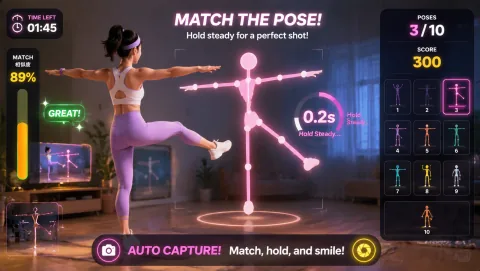
The same indoor kit covers both emergencies. When the heat index or a storm forces everyone into the rec hall, you want a plan that starts in under five minutes: clear the floor, open a browser, project the screen. Keep two calm picks ready for the last 15 minutes when campers are sweaty and wound up — pose matching and slow reaction games bring the energy down without a lecture.

Running turns with a big group

How to keep 20 kids moving with one screen

The failure mode of indoor camp games is a line of bored kids watching one player. These rules fix that without extra equipment.

Sample session

A 45-minute indoor camp block

Built for one counselor, one laptop and projector, and 16–24 campers in a rec hall. Scale heats up or down for your group size.

  1. Minutes 0–5 — setup: clear the floor, split campers into four teams, post the turn order, and open the first game on the projector.
  2. Minutes 5–15 — warm-up game: one full relay round of Neon Stomp Battle, one camper per team per song section. Low stakes, gets everyone loose.
  3. Minutes 15–35 — team tournament: elimination bracket of Reaction. Every win adds points to the cabin total on the whiteboard. Losers join the countdown squad.
  4. Minutes 35–42 — laugh break: rapid-fire Awkward Pose Studio rounds with two campers on camera at once if space allows.
  5. Minutes 42–45 — cool-down: announce the winning cabin, hand out whatever passes for a trophy, and transition to the next scheduled activity.

Endurance option

One more for the campers who never get tired

Why this format works

Built for counselor reality

Spectating stays fun

Rounds are short and visible on the big screen, so watching is part of the game. Cabins chant through each other's rounds instead of drifting to the corners of the hall.

Setup survives a chaotic schedule

Rain plans get announced five minutes before they start. A browser game on a laptop you already have beats hunting for the box of gym equipment nobody has inventoried since June.

Mixed ages share one room

Younger campers take the simple tap-and-reach heats, older campers take the reflex brackets, and everyone meets in the middle for the pose round. One activity covers the 5-to-13 spread without splitting the group.

Keep it realistic

Space and supervision notes

Give each active player a clear two-by-two meter zone and keep the waiting teams behind a taped line so nobody wanders into the camera view mid-round. During a heat wave, keep rounds short, schedule water breaks between heats, and watch for campers who look flushed or dizzy — swap them to scorekeeper duty. The webcam games need decent lighting on the player; face the play area toward a window or the hall lights, not away from them.

Questions counselors ask

FAQ

What games work for large groups indoors?

Pick games where one or two campers play short rounds while the rest of the group watches, cheers, and waits for a fast turn. Rhythm stomp battles, reaction elimination rounds, and pose-matching games all work because a round lasts one to three minutes and spectators stay engaged. Classic no-screen options like relay races, freeze dance, and charades fill the gaps between screen rounds.

How do you run turns with 20 kids and one screen?

Split campers into teams of four or five and rotate one player per round, so nobody waits more than a few minutes. Write the order on a whiteboard before you start. Use team scoring — add each player's score to a cabin total — so the kids waiting feel invested in every round instead of just their own.

What equipment do we need?

For the interactive webcam games on this page: a laptop with a camera, a projector or TV so the group can see the screen, and a cleared floor area of roughly two by two meters per player station. MovePlay's live games are free and run in the browser with no download or controller. No-screen backup games need nothing but floor space.

How do you adapt these games for mixed ages?

Run age-band heats: younger campers (5–8) play simpler reach-and-tap games like WhackAMole while older campers (9–13) take on faster reflex and endurance rounds. Pair older campers as scorekeepers and turn-callers so they stay involved during the younger heats. For all-cabin games, pick formats where effort matters more than precision, like stomp battles and pose matching.


Rain-proof the schedule

Get the whole cabin moving in the next five minutes.

Open the free game hub