🔥 Free Tool
Exercise calorie calculator
Enter your weight, pick an activity, set the duration — get an honest MET-based estimate of calories burned, including for webcam motion games.
Arm gestures, head tracking, seated motion (MET 1.8)
💡 Best games for this intensity: LaserEyes, GestureChess, CyberKnot
🎮 Play to match this burn:
MET-based estimate · individual results commonly vary by 10–20% or more
How the calorie math works
The MET method, in plain English
Your body burns about 1 kcal per kilogram per hour just resting — that's 1 MET. Every activity has a MET multiplier: brisk walking is about 4.3, jogging about 7. So calories burned ≈ MET × your weight in kg × hours. A 70 kg person doing 30 minutes at 5 MET burns roughly 5 × 70 × 0.5 = 175 kcal.
Where the numbers come from
Everyday-activity values come from the Compendium of Physical Activities — a peer-reviewed reference researchers use to standardize energy expenditure. Motion-game tiers (light ~3, moderate ~5, vigorous ~7 MET) are our estimates based on how each game type plays, not lab measurements.
An honest word on accuracy
Any estimate made without a heart-rate monitor is approximate. Fitness, body composition, age, and real effort level can push your actual burn 10–20% or more above or below the estimate. Use the result to compare activities and track trends — not as an exact calorie count.
Data Source
Activity MET values are based on the Compendium of Physical Activities: Ainsworth BE, Haskell WL, Herrmann SD, et al. (2011). "2011 Compendium of Physical Activities: A Second Update of Codes and MET Values." Medicine & Science in Sports & Exercise, 43(8), 1575–1581. Motion-game MET ranges are MovePlay estimates and are labeled as such.
Motion games as exercise: the honest picture
Light play (estimate)
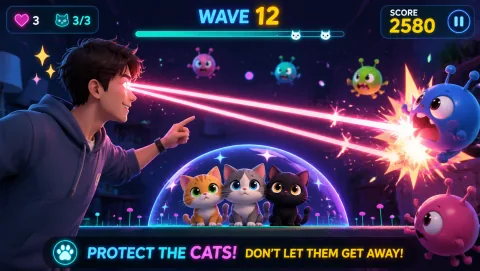
Seated-friendly, hand- and head-based games like LaserEyes, BubbleMatch, or GestureChess. Comparable to slow walking — gentle movement that still beats sitting still.
Moderate play (estimate)
Full-body games like GenkiRun (run in place) or NeonStompBattle (rhythm steps). In the same neighborhood as brisk walking or casual dancing.
Vigorous play (estimate)
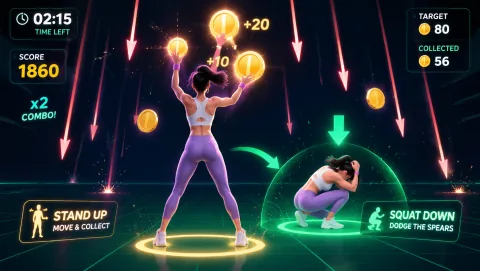
Sustained squatting and jumping games like SquatPacman and BunnyHop. Approaches jogging-level effort when played continuously.
These tiers are estimates — your actual burn depends on how hard you play. Prefer easier movement? See our guide to low-impact motion games, or browse all webcam games — 16 free titles, no downloads, no signup.
Top Games by Calorie Burn




Frequently Asked Questions
How accurate is a calorie calculator? +
Any calculator that works without heart-rate data is a rough estimate, not a measurement. The MET method — calories ≈ MET × weight in kg × hours — is a research standard for estimating average energy expenditure, but individual results commonly differ by 10–20% or more depending on fitness, body composition, age, and how hard you actually work. Use the number to compare activities and sessions — not as an exact count.
What is a MET? +
MET stands for Metabolic Equivalent of Task. A MET of 1 is the energy you burn sitting quietly — roughly 1 kcal per kilogram of body weight per hour. An activity at 5 METs burns about five times your resting rate. Researchers have measured and published MET values for hundreds of activities in the Compendium of Physical Activities, which is what this calculator is based on.
Do motion games burn many calories? +
Motion games burn calories in line with other activities of similar intensity — no more, no less. Gentle, seated, or hand-based play is roughly comparable to slow walking (around 3 MET, estimated), while vigorous full-body games with squats, jumps, and running in place can approach jogging-level effort (around 7 MET, estimated). For a 70 kg adult, a 20-minute moderate motion-game session works out to roughly 115 kcal — meaningful movement, especially compared to sitting still. Try it yourself with GenkiRun or BunnyHop.
Should I use this calculator for weight loss? +
Treat it as one input among many. Weight change depends primarily on your overall energy balance — food intake matters at least as much as exercise, and individual metabolism varies widely. A calorie calculator can help you compare activities and build awareness, but for a personal weight-loss plan, talk to a doctor or a registered dietitian who can account for your full health picture.