Printable session plan · Small-Space and Lower-Impact Play

Dorm-Room Motion Games: run of show

A practical, time-bounded plan for college students in dorms in a shared dorm room. Use it to rehearse one clear activity without improvising the room, camera, or participation rules.

Give the session one clear job

The practical question is how to add interactive play without a console or open floor when roommates, furniture, and quiet hours constrain the setup.

This is a run-of-show companion to the broader Dorm-Room Motion Games use-case guide. Its purpose is narrower: help the operator or host run one thoughtful session with a defined start, a clear option to pause, and a prepared fallback.

MovePlay includes games controlled by hands, gestures, poses, and contained upper-body movement. Selecting from those real formats lets players reduce travel across the floor while still interacting through the camera.

Walk through the room before the first turn

01

Set the footprint

Mark and test the operating footprint. Frame a shared dorm room around the space that genuinely exists: one marked position away from furniture, door swings, loose cables, pets, and household traffic. Test BubbleMatch inside its compact standing space with light movement footprint and keep later rounds within the same boundary.

02

Open the round

Rehearse the exact opening moment. The useful first move for college students in dorms is one BubbleMatch round in a shared dorm room. Its two-hand pointing and color matching creates a defined attempt to add interactive play without a console or open floor; after it ends, the player can continue, change pace, or finish.

03

Guide the rotation

Choose and rehearse the personal sequence. For a shared dorm room, check the floor and framing once, complete a bounded BubbleMatch attempt, and notice whether two-hand pointing and color matching still fits. Move to GestureChess only when its hand pointing and pinch selection suits the room and the player wants another turn.

04

Close or change course

Set the privacy and stop choices before starting. When starting a shared dorm room, check what the camera reveals behind the player as well as the play area. Keep the session unrecorded by default, notify other people nearby, and never assume that entering the room means agreeing to be on camera. If the real constraint is that roommates, furniture, and quiet hours constrain the setup, use GestureChess as the lower-movement route or finish the session. The plan remains useful when it makes stopping easy instead of turning a short activity into an obligation.

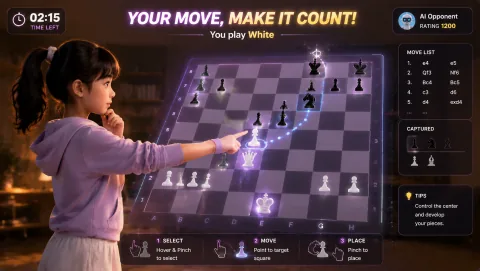
Decision standard: The format can add interactive play without a console or open floor without interfering with the main purpose of a shared dorm room.

Choose a first round that fits this room

A good game order for a shared dorm room makes the host’s next sentence obvious. Begin with a readable cue, then keep an alternative ready for the people who prefer less movement or no camera.

Gesture Chess webcam motion game

hand pointing and pinch selection

Gesture Chess

Gesture Chess is included for Dorm-Room Motion Games because it uses hand pointing and pinch selection in seated or compact standing space with low movement.

Play fit: calm, self-paced sessions where strategy matters more than speed For dorm-room motion games, plan for seated or compact standing space with low movement.

Snow Trail webcam motion game

shoulder leaning with optional half-squats

Snow Trail

Snow Trail is included for Dorm-Room Motion Games because it uses shoulder leaning with optional half-squats in compact standing space with light-to-moderate movement.

Play fit: controlled, lower-travel play with an easy-to-read steering loop For dorm-room motion games, plan for compact standing space with light-to-moderate movement.

Later choices: LaserEyes. Let comfort and available space set the pace in a shared dorm room. GestureChess provides hand pointing and pinch selection with seated or compact standing space with low movement; the player can choose it first, switch to it later, or skip play without losing the value of a bounded routine.

Keep the camera view and the exit clear

Space and light

Frame a shared dorm room around the space that genuinely exists: one marked position away from furniture, door swings, loose cables, pets, and household traffic. Test BubbleMatch inside its compact standing space with light movement footprint and keep later rounds within the same boundary. Test camera framing and backlight from that exact zone before the first BubbleMatch turn.

Access and privacy

Let comfort and available space set the pace in a shared dorm room. GestureChess provides hand pointing and pinch selection with seated or compact standing space with low movement; the player can choose it first, switch to it later, or skip play without losing the value of a bounded routine. When starting a shared dorm room, check what the camera reveals behind the player as well as the play area. Keep the session unrecorded by default, notify other people nearby, and never assume that entering the room means agreeing to be on camera. Everyone has the right to opt out, choose an observer role, or stop the activity without having to explain or justify that choice.

Fallback

If the real constraint is that roommates, furniture, and quiet hours constrain the setup, use GestureChess as the lower-movement route or finish the session. The plan remains useful when it makes stopping easy instead of turning a short activity into an obligation.

Use active play responsibly

For college students in dorms, keep the promise modest: a clear, optional activity with a prepared fallback. Apply the requirements that govern your setting before running the session.

For college students in dorms, the WHO Guidelines are useful background, not a scorecard. Apply the safeguarding, accessibility, and privacy requirements that govern a shared dorm room. WHO Guidelines on physical activity and sedentary behaviour.

What to observe here: The format can add interactive play without a console or open floor without interfering with the main purpose of a shared dorm room.

Answers to settle before the session

What is the opening move for Dorm-Room Motion Games?

The useful first move for college students in dorms is one BubbleMatch round in a shared dorm room. Its two-hand pointing and color matching creates a defined attempt to add interactive play without a console or open floor; after it ends, the player can continue, change pace, or finish.

How should the space and camera be prepared?

Frame a shared dorm room around the space that genuinely exists: one marked position away from furniture, door swings, loose cables, pets, and household traffic. Test BubbleMatch inside its compact standing space with light movement footprint and keep later rounds within the same boundary. Test camera framing and backlight from that exact zone before the first BubbleMatch turn.

What if the planned round no longer fits the room?

If the real constraint is that roommates, furniture, and quiet hours constrain the setup, use GestureChess as the lower-movement route or finish the session. The plan remains useful when it makes stopping easy instead of turning a short activity into an obligation.