One screen can be enough for a whole-class movement activity if the game is designed around shared cues rather than individual device input.
The key is to keep every student active even when only one screen or one camera is available.
In a classroom, an activity has to work for the teacher as well as the students. If the projector, camera, or permissions need live troubleshooting, the activity is not low-prep that day. That is what turns a fun idea into a classroom tool.
Formats that work under PE constraints
Everyone follows the screen
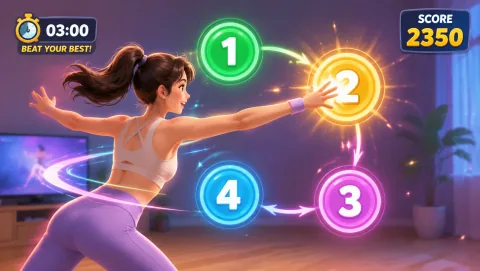
Project arrows, colors, numbers, or poses. Students respond together from personal spaces.
This is the simplest format because the screen is only a visual cue.
If one student is active and five are waiting, change the rotation before adding more features to the game.
One player, class mirrors
A student plays a camera-controlled or reaction game at the front while the rest of the class copies the movement.
Rotate the lead player every short round so the role stays special but not exclusive.
Offer an easier movement range without making it feel like a public 'easy version.'
Teams predict the next move
Divide the class into teams. One player completes a challenge while teammates predict, call instructions, or keep score.
This adds group involvement without requiring simultaneous camera tracking.
Use the digital feedback as one source of information, not as a substitute for teacher observation.
Whole-class score
Set a shared target: number of correct reactions, sequence length, or total successful rounds. Avoid turning every activity into student-versus-student competition.
Keep a non-digital station ready so a browser or camera problem does not stop the lesson.
Movement quiz
Map answers to body positions or directions. Students show their answer physically, then discuss.
Give the station a clear zone, time limit, and reset instruction before the first student starts.
Using MovePlay with one screen
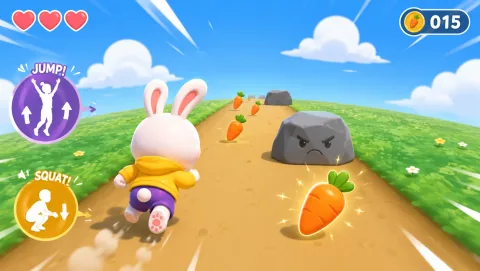
A MovePlay game can be used as the front-of-room interactive layer while classmates mirror or rotate through turns. Reaction and pose games are usually easier for this than games that depend on individual progression.
The camera should frame only the active play area, and participation should not require every student to appear on camera.
One screen works best when the rest of the class has a role—mirror the player, predict the answer, keep a team score, or rotate through another station instead of simply watching.
What makes it work in PE:
The most important classroom detail is often the transition nobody puts in the title. If the projector, camera, or permissions need live troubleshooting, the activity is not low-prep that day. That is what turns a fun idea into a classroom tool.
Keep transitions fast
Choose games with rounds under two or three minutes. One screen becomes frustrating when one student controls it for ten minutes while 29 others wait.
The best one-screen classroom game treats the screen as a shared prompt, not as a scarce device everyone has to compete for.
One thing I would not ignore:
Teachers benefit more from reliable formats than from endless novelty. If the projector, camera, or permissions need live troubleshooting, the activity is not low-prep that day. That is what turns a fun idea into a classroom tool.
Use technology where it solves something:
A classroom game earns its place when it fits the room, the clock, and the lesson. If the projector, camera, or permissions need live troubleshooting, the activity is not low-prep that day. That is what turns a fun idea into a classroom tool.
Make the activity work in the real timetable
Best fit: use this when the teacher can explain one visible rule, keep the first turn brief, and give students a clear way to watch, lead, or pause without being singled out.
Limit: it is a poor fit when setup takes longer than the learning goal, the room cannot be reset safely, or the scoring rewards speed over control. A lower-tech version may teach the same idea better.
If you are choosing: If you are choosing between formats, begin with the option that needs the fewest materials and the least movement across the room. Test one round before committing the whole class.