At a corporate event, only a small share of the room may be playing at any one moment. A good game gives everyone else something to watch, predict, or react to.
B2B use changes the definition of a good game. The activity should still work after the original designer leaves and a different staff member takes over. That is the difference between a demo and something a venue can actually operate.
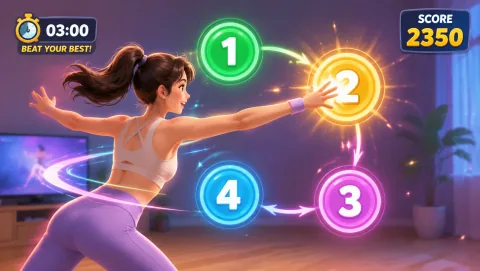
Score attack on a large screen
Use a short reaction, accuracy, or movement challenge with visible scoring. The audience understands progress without hearing instructions.
Staff time and reset time are part of product quality in a live environment. The activity should still work after the original designer leaves and a different staff member takes over. That is the difference between a demo and something a venue can actually operate.
Public and commercial activities have to survive operational reality. Round length, reset steps, throughput, visibility from a distance, staffing, and a fallback plan can matter as much as the game mechanic. Operational clarity is what lets a good idea scale beyond one enthusiastic facilitator.
Team representative rounds
Each table or department sends one player while the group contributes to a shared score.
At a booth or venue, the game is only one part of the experience. Round length, reset steps, throughput, visibility from a distance, staffing, and a fallback plan can matter as much as the game mechanic. Operational clarity is what lets a good idea scale beyond one enthusiastic facilitator.
Prediction challenge
Spectators guess the winner, final score, or result before the round starts.
A successful activity creates a queue, which means the queue has to be designed too. Round length, reset steps, throughput, visibility from a distance, staffing, and a fallback plan can matter as much as the game mechanic. Operational clarity is what lets a good idea scale beyond one enthusiastic facilitator.
B2B use changes the definition of a good game. Round length, reset steps, throughput, visibility from a distance, staffing, and a fallback plan can matter as much as the game mechanic. Operational clarity is what lets a good idea scale beyond one enthusiastic facilitator.
Physical mini-game with commentary
Simple target throws, balance challenges, or timed stacking become more watchable with a host and visible score.
Staff time and reset time are part of product quality in a live environment. Round length, reset steps, throughput, visibility from a distance, staffing, and a fallback plan can matter as much as the game mechanic. Operational clarity is what lets a good idea scale beyond one enthusiastic facilitator.
One-screen motion game:
A camera-based game works well when the player’s body movement is visible alongside the game feedback. Short rounds make rotation easy.
Avoid long private interactions:
VR can be immersive for the player but may be less interesting to a crowd unless the experience is mirrored and explained well.
Make participation optional
Not everyone wants to perform in front of colleagues. Observer, scorekeeper, team strategist, and host roles should be legitimate ways to join.
Spectator value is a design feature. If the game is only fun for the person holding the controller, it may be the wrong event format.
Public and commercial activities have to survive operational reality. Spectators should be able to understand what is happening quickly so watching one round naturally recruits the next participant. Operational clarity is what lets a good idea scale beyond one enthusiastic facilitator.
Keep the social pressure lower than the benefit
Best fit: this is useful when people can join for a short reset, understand the invitation immediately, and leave without having to explain why they are sitting out.
Limit: it is a poor choice when participation is treated as a performance, the activity competes with a serious meeting, or colleagues have very different comfort levels with cameras and movement.
If you are choosing: If you are choosing between ideas, prefer a short optional round with a personal target over a public leaderboard. The goal is an easier break, not another workplace metric.