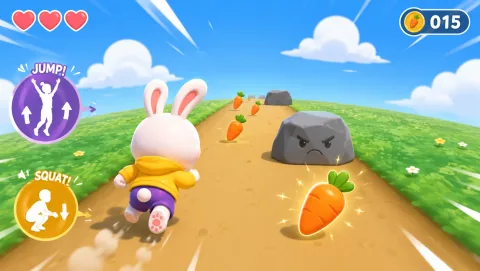
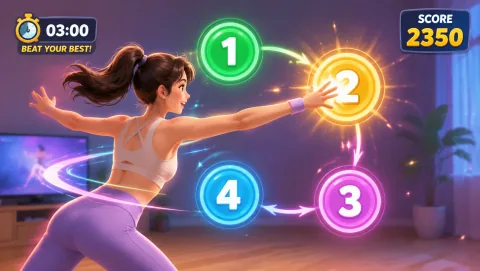
A small room changes what “active” means. Games that expect running, wide lunges, or big lateral steps can become frustrating or unsafe when the player only has a narrow area in front of a desk or sofa.
The goal is meaningful participation, not identical movement. Difficulty can grow through memory, sequencing, precision, or choice rather than demanding larger and faster movements. Inclusive design is often less about adding modes than removing unnecessary obstacles.
Prioritize vertical and upper-body controls
Reaching, hand tracking, shallow squats, leaning, and arm poses usually fit a tighter footprint than running or jumping sideways.
Accessibility is strongest when alternatives exist before anyone has to ask for them. A seated version only works if the targets, framing, and controls are genuinely reachable from a chair. Inclusive design is often less about adding modes than removing unnecessary obstacles.
Difficulty can come from memory, choices, or timing instead of requiring a larger physical range.
A feature label does not tell you whether an activity is comfortable in the real room. A seated version only works if the targets, framing, and controls are genuinely reachable from a chair. Inclusive design is often less about adding modes than removing unnecessary obstacles.
Keep the player centered
Games are easier in small spaces when the player can stay in one camera zone instead of chasing targets around the room.
Inclusive motion play is mostly a collection of practical design choices. A seated version only works if the targets, framing, and controls are genuinely reachable from a chair. Inclusive design is often less about adding modes than removing unnecessary obstacles.
The player's actual position is the right place to evaluate the experience. A seated version only works if the targets, framing, and controls are genuinely reachable from a chair. Inclusive design is often less about adding modes than removing unnecessary obstacles.
Watch arm clearance
Limited floor space is only half the issue. Lamps, shelves, ceiling fans, and nearby people can make wide arm movements a problem.
The goal is meaningful participation, not identical movement. A seated version only works if the targets, framing, and controls are genuinely reachable from a chair. Inclusive design is often less about adding modes than removing unnecessary obstacles.
Use the smallest comfortable movement range:
If tracking requires exaggerated movement, the game may not be suitable for the room. Do not compensate by squeezing closer to furniture.
Test one round before committing
Stand or sit in the intended spot and deliberately reach to every edge of the game’s normal movement range. If you touch furniture, change the game or the setup.
Small-space play works best when the game was chosen for the room rather than forcing the room to accommodate the game.
Accessibility is strongest when alternatives exist before anyone has to ask for them. Observer, scorekeeper, and chooser roles should feel like normal ways to participate, not consolation prizes. Inclusive design is often less about adding modes than removing unnecessary obstacles.
Judge the format by the device and the room
Best fit: start here when the device is already available, the camera view is understandable, and the activity can be completed without moving furniture or sharing more video than necessary.
Limit: it is a weaker choice when the connection is unstable, the frame is crowded, the light makes tracking unreliable, or the player needs a movement the camera cannot read consistently.
If you are choosing: If you are choosing between a digital and an offline version, test the first cue before choosing the game. Use the offline option when it gives clearer feedback or a more comfortable way to participate.