Reaction games can be enjoyable for older adults when the cues are clear, the targets are large, and speed is treated as adjustable rather than as the whole point.
Simple rules do not require childish presentation. Large cues, generous timing, short rounds, and seated or standing options reduce unnecessary barriers without removing humor or challenge. The most meaningful signal is often whether people want another round.
Color touch
Place several colored targets within comfortable reach. Call a color and touch the matching target.
Mixed ability is normal in older-adult groups, not an edge case. Large cues, generous timing, short rounds, and seated or standing options reduce unnecessary barriers without removing humor or challenge. The most meaningful signal is often whether people want another round.
Direction call
Use left, right, high, low, and center. Respond by pointing, reaching, or stepping depending on ability.
A good activity can stay challenging while becoming easier to access physically. Large cues, generous timing, short rounds, and seated or standing options reduce unnecessary barriers without removing humor or challenge. The most meaningful signal is often whether people want another round.
The useful design question is how much choice the participant has. Large cues, generous timing, short rounds, and seated or standing options reduce unnecessary barriers without removing humor or challenge. The most meaningful signal is often whether people want another round.
Clap on the cue:
Read a list of words and ask the player to clap only when a target word or category appears.
Short rounds make rest easier and reduce the social pressure to continue when someone is tired.
Number order
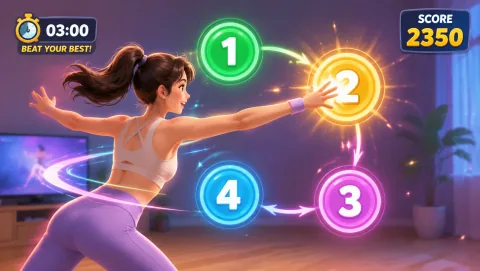
Display several large numbers and touch them in ascending order. Use fewer targets and more time for an easier version.
Activities for older adults should begin with the person, not the age label. Music, accuracy, memory, teamwork, and prediction can create plenty of game value without relying on fast footwork. The most meaningful signal is often whether people want another round.
Partner mirror:
One person moves; the other responds by mirroring. This adds social interaction without relying on a timer.
Digital reaction games:
A webcam or tablet game can present visual targets automatically. MovePlay’s target-based games can fit this category, but choose the title carefully and increase camera distance, contrast, or target size where the product allows it.
Make speed optional:
A reaction game does not need to rank people by milliseconds. Track accuracy, completion, or personal improvement instead.
Watch for sensory barriers
Small text, low contrast, fast flashing cues, and audio-only instructions can make a simple game harder than intended.
The best reaction game has a clear cue-response relationship and enough time for the player to understand what happened. “Faster” is only one possible difficulty setting.
Simple rules do not require childish presentation. Music, accuracy, memory, teamwork, and prediction can create plenty of game value without relying on fast footwork. The most meaningful signal is often whether people want another round.
Keep the social pressure lower than the benefit
Best fit: this is useful when people can join for a short reset, understand the invitation immediately, and leave without having to explain why they are sitting out.
Limit: it is a poor choice when participation is treated as a performance, the activity competes with a serious meeting, or colleagues have very different comfort levels with cameras and movement.
If you are choosing: If you are choosing between ideas, prefer a short optional round with a personal target over a public leaderboard. The goal is an easier break, not another workplace metric.