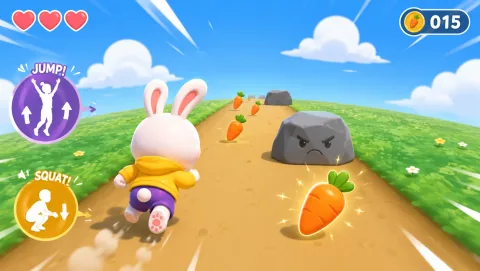
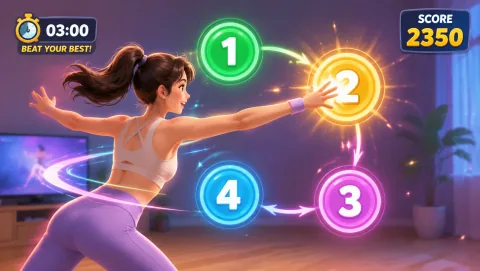
Side-to-side motion games use lateral steps, leans, or body shifts as the core control. They are useful for dodging, lane changes, balancing, and rhythm mechanics.
A strong motion mechanic makes the connection between body and screen obvious. Large targets and forgiving timing are useful for learning; complexity can be added after the basic control loop already feels fair. That is what makes the body feel like a usable controller rather than a calibration exercise.
Three common control styles
Leaning
The player keeps the feet mostly in place and shifts the upper body or body center. This needs the least space.
Side stepping
The player moves one or two steps into left and right zones. This feels more active but requires clear floor space.
Lateral jumping
The player jumps between zones. This is energetic but not suitable for every room or player.
The player should not have to think constantly about how the tracking system works. Large targets and forgiving timing are useful for learning; complexity can be added after the basic control loop already feels fair. That is what makes the body feel like a usable controller rather than a calibration exercise.
Good motion design filters out movement that does not matter to the game. Large targets and forgiving timing are useful for learning; complexity can be added after the basic control loop already feels fair. That is what makes the body feel like a usable controller rather than a calibration exercise.
Keep zones visually obvious
Players should know where “left” and “right” begin without looking at their feet.
Physical difficulty and game difficulty do not have to be the same thing. Large targets and forgiving timing are useful for learning; complexity can be added after the basic control loop already feels fair. That is what makes the body feel like a usable controller rather than a calibration exercise.
Readable feedback is part of the control scheme, not decoration. Large targets and forgiving timing are useful for learning; complexity can be added after the basic control loop already feels fair. That is what makes the body feel like a usable controller rather than a calibration exercise.
Test room width
A camera can see the player while furniture still makes the movement unsafe. Check physical clearance separately from tracking.
A strong motion mechanic makes the connection between body and screen obvious. Players need to know whether they missed the target or the system missed the movement, otherwise every failure feels like bad tracking. That is what makes the body feel like a usable controller rather than a calibration exercise.
The player should not have to think constantly about how the tracking system works. Players need to know whether they missed the target or the system missed the movement, otherwise every failure feels like bad tracking. That is what makes the body feel like a usable controller rather than a calibration exercise.
Avoid drift
Players often gradually move away from the starting point. Add center/reset moments so they do not end up beside a wall.
Side-to-side games can feel fast and athletic without requiring forward running. The right version depends on whether the space supports leaning, stepping, or jumping.
Good motion design filters out movement that does not matter to the game. Players need to know whether they missed the target or the system missed the movement, otherwise every failure feels like bad tracking. That is what makes the body feel like a usable controller rather than a calibration exercise.
Judge the format by the device and the room
Best fit: start here when the device is already available, the camera view is understandable, and the activity can be completed without moving furniture or sharing more video than necessary.
Limit: it is a weaker choice when the connection is unstable, the frame is crowded, the light makes tracking unreliable, or the player needs a movement the camera cannot read consistently.
If you are choosing: If you are choosing between a digital and an offline version, test the first cue before choosing the game. Use the offline option when it gives clearer feedback or a more comfortable way to participate.