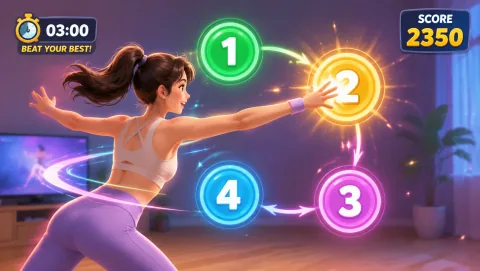
A webcam game does not have to require standing, jumping, or full-body movement. Seated play can work well when the game responds to hand movement, reaching, pointing, upper-body poses, or head and shoulder motion.
Accessibility is strongest when alternatives exist before anyone has to ask for them. Target height, reach distance, camera angle, reaction time, contrast, sound dependence, and role design can all create or remove barriers. That approach produces flexibility people can use without drawing attention to why they need it.
What makes a webcam game suitable for seated play?
Look for large visual targets, generous timing, minimal need to move toward the edge of the camera frame, and controls that do not depend on leg position.
Hand-tracking games are often a natural fit. Upper-body pose games can also work if the camera is positioned high enough to see the player clearly.
Difficulty can come from memory, choices, or timing instead of requiring a larger physical range.
A feature label does not tell you whether an activity is comfortable in the real room. Target height, reach distance, camera angle, reaction time, contrast, sound dependence, and role design can all create or remove barriers. That approach produces flexibility people can use without drawing attention to why they need it.
Inclusive motion play is mostly a collection of practical design choices. Target height, reach distance, camera angle, reaction time, contrast, sound dependence, and role design can all create or remove barriers. That approach produces flexibility people can use without drawing attention to why they need it.
Set up the camera differently
Place the camera roughly at upper-body height rather than leaving a laptop low on a table. Keep the player’s hands and shoulders visible through the full movement range.
Move the chair far enough from the screen that reaching does not push hands outside the frame.
The player's actual position is the right place to evaluate the experience. Target height, reach distance, camera angle, reaction time, contrast, sound dependence, and role design can all create or remove barriers. That approach produces flexibility people can use without drawing attention to why they need it.
The goal is meaningful participation, not identical movement. Target height, reach distance, camera angle, reaction time, contrast, sound dependence, and role design can all create or remove barriers. That approach produces flexibility people can use without drawing attention to why they need it.
Avoid assuming seated means easy:
Fast reaction games can still be demanding. Start with slower rounds and increase speed only if the player wants more challenge.
Keep the floor clear:
Even seated players may shift, reach, or rotate. Remove loose cables, small tables, and objects that could catch an arm or wheel.
Choose the game for the person, not the label
Some people use a chair because of mobility; others simply prefer sitting. Do not turn the setup into a medical category. The useful question is whether the controls fit the player’s comfortable movement range.
Accessibility is strongest when alternatives exist before anyone has to ask for them. Difficulty can grow through memory, sequencing, precision, or choice rather than demanding larger and faster movements. That approach produces flexibility people can use without drawing attention to why they need it.
Judge the format by the device and the room
Best fit: start here when the device is already available, the camera view is understandable, and the activity can be completed without moving furniture or sharing more video than necessary.
Limit: it is a weaker choice when the connection is unstable, the frame is crowded, the light makes tracking unreliable, or the player needs a movement the camera cannot read consistently.
If you are choosing: If you are choosing between a digital and an offline version, test the first cue before choosing the game. Use the offline option when it gives clearer feedback or a more comfortable way to participate.