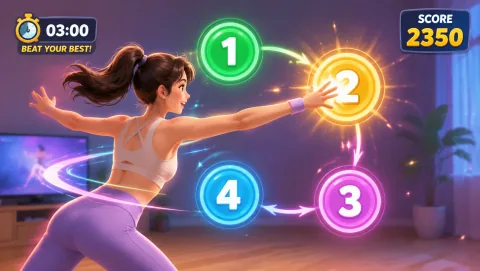
If a child already wants screen time, one practical option is to choose games that require movement rather than trying to turn every digital session into a negotiation.
The best active screen games make movement part of the control, not an optional break between long stretches of sitting.
The label on the app matters less than the behavior it produces. A finite round is easier to manage than an endless feed, and active input is different from simply letting a video run. That gives families a more workable rule than counting every minute as identical.
Formats worth considering
Dance games
Dance games are one of the most obvious categories. The child follows choreography, copies moves, or tries to match rhythm cues.
They work well for kids who enjoy music, but less well for children who feel self-conscious about dancing or struggle to follow a routine.
This is a good option when music itself is motivating. It is a weaker fit for children who dislike performing choreography; in that case, reaction or arcade-style movement may feel more like a game and less like a class.
Camera-controlled games
Webcam games use the camera to detect body or hand movement. The child may reach toward targets, squat, jump, pose, swipe, or move side to side.
MovePlay is one browser-based example. Fruit Slash uses sweeping arm movement, Reaction uses reaching, SquatPacman uses squat-and-stand movement, and BunnyHop uses larger full-body actions.
The advantage is low hardware friction: many laptops already have a camera. The trade-off is that webcam tracking is less precise than dedicated depth sensors or VR controllers and needs decent lighting and framing.
When evaluating digital play, I would look past the word 'educational' or 'active' on the product page. A finite round is easier to manage than an endless feed, and active input is different from simply letting a video run. That gives families a more workable rule than counting every minute as identical.
Console motion games
Systems such as Nintendo Switch can use motion-capable controllers for sports, dance, and fitness games. They usually provide more consistent controller input than a normal webcam but require the console and accessories.
For families that already own the hardware, these can be excellent active options.
If the household already owns the console, this can be one of the lowest-friction choices. Buying new hardware purely to create 'better screen time' is a different decision and should be judged against how often the family will really use it.
VR movement games
VR can create highly immersive active play, from rhythm games to boxing and sports. It also adds cost, headset comfort, age guidance, and space considerations.
It is not the simplest choice for every child or every household.
VR can create a lot of movement, but it changes the social dynamic because the player is inside a headset. For family use, consider whether spectatorship and quick player swapping matter to you.
Active video challenges
A child can also use an ordinary screen for follow-along movement: yoga, dance, simple workouts, or game-like “choose your move” videos.
These do not need tracking. The screen demonstrates; the child follows.
The useful test is whether the child stays involved in making decisions rather than sliding back into passive watching.
How I would judge the screen activity
Screen time becomes easier to reason about when you stop treating every screen activity as the same thing. The same device can be part of a creative hour or part of a passive one; context decides which it is. That gives families a more workable rule than counting every minute as identical.
What to look for
Choose games based on the child and the room:
- simple first-round rules;
- movement that is safe in your available space;
- short rounds or natural stopping points;
- no pressure to perform at an adult fitness level;
- replay value beyond one novelty session;
- appropriate privacy and account settings.
An active game is still screen time. Its advantage is narrower and more practical: it can turn part of that screen time into a period when the child is physically participating rather than only watching.
One thing I would not ignore
For parents, the more useful distinction is what the child is doing with the screen. The same device can be part of a creative hour or part of a passive one; context decides which it is. That gives families a more workable rule than counting every minute as identical.
How I would think about it
A screen can support very different behaviors, from passive viewing to creating, talking, solving, or moving. The same device can be part of a creative hour or part of a passive one; context decides which it is. That gives families a more workable rule than counting every minute as identical.
Choose it for the group in front of you
Best fit: this works when the ages and confidence levels can share one simple goal, with an adult able to explain the first round and step in if the room loses focus.
Limit: it is a weaker choice when children are tired, the ages are far apart, or one person is expected to perform in front of everyone. A quieter role or a shorter round may be the better answer.
If you are choosing: start with the smallest version that can succeed in the available space. Add speed, scoring, or competition only after the group understands the basic action.