Rhythm motion games connect movement to a beat, musical phrase, or repeating timing pattern. They can feel more like dancing, drumming, or playing than traditional exercise.
Good motion design filters out movement that does not matter to the game. Re-centering moments and short rounds help people recover from drift, missed inputs, and awkward starting positions. That is what makes the body feel like a usable controller rather than a calibration exercise.
Common rhythm mechanics
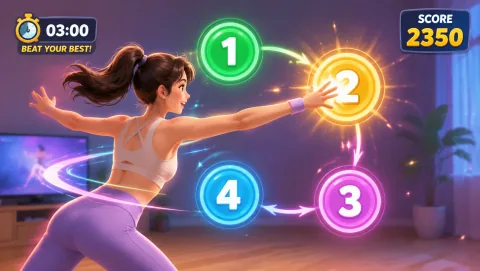
Hit on the beat
Targets reach a timing line and the player moves a hand, foot, or body part at the right moment.
Copy a movement phrase
The game demonstrates a short pattern and the player repeats it with the music.
Alternate sides
Left-right patterns create a simple rhythm without requiring dance experience.
Hold and release
Some notes require the player to maintain a pose until the beat changes.
Physical difficulty and game difficulty do not have to be the same thing. Re-centering moments and short rounds help people recover from drift, missed inputs, and awkward starting positions. That is what makes the body feel like a usable controller rather than a calibration exercise.
Readable feedback is part of the control scheme, not decoration. Re-centering moments and short rounds help people recover from drift, missed inputs, and awkward starting positions. That is what makes the body feel like a usable controller rather than a calibration exercise.
What matters more than musical complexity
Latency is critical. If visual or audio timing does not match the response window, a rhythm game feels unfair quickly.
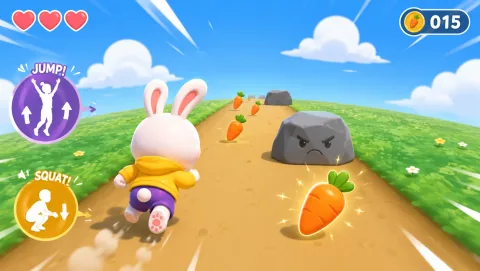
A strong motion mechanic makes the connection between body and screen obvious. Reach, dodge, pose, rhythm, and squat controls work best when the on-screen result matches what the movement naturally suggests. A mechanic is strongest when it remains clear even for a first-time player.
The player should not have to think constantly about how the tracking system works. Reach, dodge, pose, rhythm, and squat controls work best when the on-screen result matches what the movement naturally suggests. A mechanic is strongest when it remains clear even for a first-time player.
Good motion design filters out movement that does not matter to the game. Reach, dodge, pose, rhythm, and squat controls work best when the on-screen result matches what the movement naturally suggests. A mechanic is strongest when it remains clear even for a first-time player.
Beginner-friendly design
Use a strong beat, repeated patterns, and clear visual cues. Increase difficulty by adding sequence complexity before simply making everything faster.
Physical difficulty and game difficulty do not have to be the same thing. Reach, dodge, pose, rhythm, and squat controls work best when the on-screen result matches what the movement naturally suggests. A mechanic is strongest when it remains clear even for a first-time player.
When rhythm games work best
They are useful for family play, classroom movement, warm-ups, and people who find repetitive exercise boring. They are less suitable when the room must stay silent unless the game has strong visual timing cues.
The appeal is not that rhythm magically improves exercise. It is that timing gives movement a reason and makes repetition feel like part of the game.
Readable feedback is part of the control scheme, not decoration. Reach, dodge, pose, rhythm, and squat controls work best when the on-screen result matches what the movement naturally suggests. A mechanic is strongest when it remains clear even for a first-time player.
Make the activity work in the real timetable
Best fit: use this when the teacher can explain one visible rule, keep the first turn brief, and give students a clear way to watch, lead, or pause without being singled out.
Limit: it is a poor fit when setup takes longer than the learning goal, the room cannot be reset safely, or the scoring rewards speed over control. A lower-tech version may teach the same idea better.
If you are choosing: If you are choosing between formats, begin with the option that needs the fewest materials and the least movement across the room. Test one round before committing the whole class.