Editorial supplement
More ways to judge Best Reaction Games You Can Play With a Webcam
Reaction games are one of the best fits for webcam input because the goal is immediately visible: a target appears, you move toward it, and the game tells you whether you were fast enough.
A strong motion mechanic makes the connection between body and screen obvious. Reach, dodge, pose, rhythm, and squat controls work best when the on-screen result matches what the movement naturally suggests. That is what makes the body feel like a usable controller rather than a calibration exercise.
The player should not have to think constantly about how the tracking system works. Reach, dodge, pose, rhythm, and squat controls work best when the on-screen result matches what the movement naturally suggests. That is what makes the body feel like a usable controller rather than a calibration exercise.
What makes a good webcam reaction game?
Look for clear targets, generous hit areas, visible timing, and controls that match the camera setup. Hand-only games need little room; full-body reaction games may ask you to reach, step, duck, or lean.
Good motion design filters out movement that does not matter to the game. Reach, dodge, pose, rhythm, and squat controls work best when the on-screen result matches what the movement naturally suggests. That is what makes the body feel like a usable controller rather than a calibration exercise.
Physical difficulty and game difficulty do not have to be the same thing. Reach, dodge, pose, rhythm, and squat controls work best when the on-screen result matches what the movement naturally suggests. That is what makes the body feel like a usable controller rather than a calibration exercise.
Useful formats
Reach targets
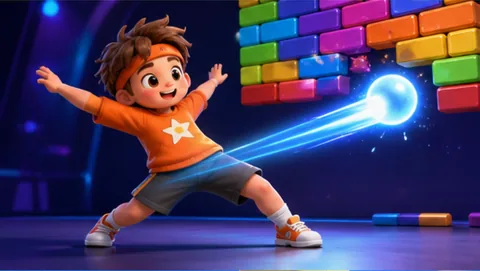
Targets appear around the screen and you touch or point toward them. These are simple to understand and easy to scale in speed.
Color-choice games
Several targets appear, but only one color or symbol should be hit. This adds decision-making instead of pure speed.
Sequence reactions
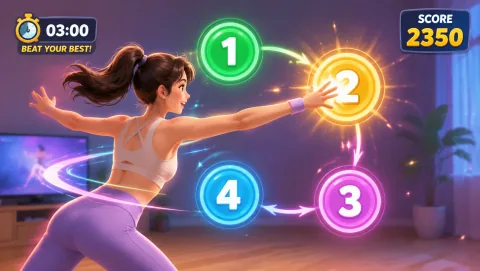
Targets must be hit in a specific order. Difficulty comes from switching attention as well as moving quickly.
Dodge-and-react games
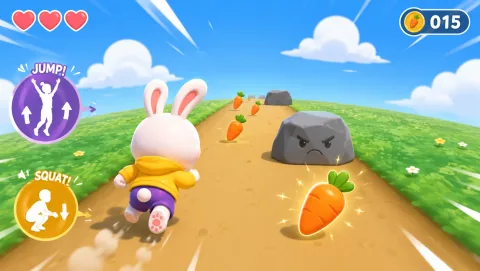
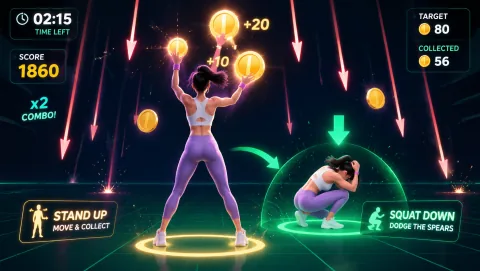
Instead of hitting something, the player moves away from an obstacle or shifts into a safe zone.
Readable feedback is part of the control scheme, not decoration. Reach, dodge, pose, rhythm, and squat controls work best when the on-screen result matches what the movement naturally suggests. That is what makes the body feel like a usable controller rather than a calibration exercise.
How to choose
For children and first-time players, choose large targets and slower timing. For adults or competitive groups, use shorter windows, smaller targets, or score streaks.
A good reaction game should feel responsive before it feels difficult. If players are fighting the camera instead of the challenge, fix the setup or choose a simpler control scheme.
A strong motion mechanic makes the connection between body and screen obvious. Memory, timing, target choice, sequencing, and precision can make a game harder without simply demanding a bigger physical range. That is what makes the body feel like a usable controller rather than a calibration exercise.
Choose it for the group in front of you
Best fit: this works when the ages and confidence levels can share one simple goal, with an adult able to explain the first round and step in if the room loses focus.
Limit: it is a weaker choice when children are tired, the ages are far apart, or one person is expected to perform in front of everyone. A quieter role or a shorter round may be the better answer.
If you are choosing: start with the smallest version that can succeed in the available space. Add speed, scoring, or competition only after the group understands the basic action.