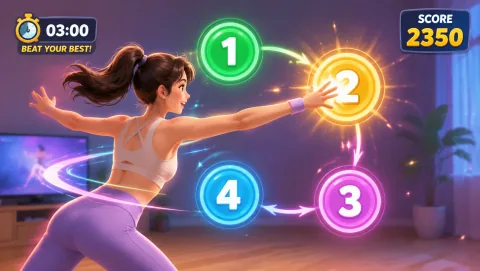
Reach-and-touch games are among the most flexible webcam formats. Targets appear on screen and the player reaches a hand—or sometimes a foot—toward the matching area.
Good motion design filters out movement that does not matter to the game. Reach, dodge, pose, rhythm, and squat controls work best when the on-screen result matches what the movement naturally suggests. That is what makes the body feel like a usable controller rather than a calibration exercise.
Why the mechanic works
There is almost no learning curve. Players understand the relationship between the target and their movement immediately.
Physical difficulty and game difficulty do not have to be the same thing. Reach, dodge, pose, rhythm, and squat controls work best when the on-screen result matches what the movement naturally suggests. That is what makes the body feel like a usable controller rather than a calibration exercise.
Readable feedback is part of the control scheme, not decoration. Reach, dodge, pose, rhythm, and squat controls work best when the on-screen result matches what the movement naturally suggests. That is what makes the body feel like a usable controller rather than a calibration exercise.
A strong motion mechanic makes the connection between body and screen obvious. Memory, timing, target choice, sequencing, and precision can make a game harder without simply demanding a bigger physical range. That is what makes the body feel like a usable controller rather than a calibration exercise.
Ways to add depth
Use target order, colors, numbers, changing sides, moving targets, memory sequences, or “avoid this one” rules.
The player should not have to think constantly about how the tracking system works. Memory, timing, target choice, sequencing, and precision can make a game harder without simply demanding a bigger physical range. That is what makes the body feel like a usable controller rather than a calibration exercise.
Space requirements
The player mainly needs arm clearance and enough camera distance to keep both hands visible. That makes reach games a strong fit for classrooms, offices, bedrooms, and seated play.
Good motion design filters out movement that does not matter to the game. Memory, timing, target choice, sequencing, and precision can make a game harder without simply demanding a bigger physical range. That is what makes the body feel like a usable controller rather than a calibration exercise.
Physical difficulty and game difficulty do not have to be the same thing. Memory, timing, target choice, sequencing, and precision can make a game harder without simply demanding a bigger physical range. That is what makes the body feel like a usable controller rather than a calibration exercise.
Scale the challenge carefully:
For beginners, use large targets and long response windows. Increase difficulty through speed, decision-making, or sequence length before shrinking targets so far that tracking becomes frustrating.
Good group use
Short rounds make reach games easy to rotate through family members, students, or event participants. Spectators can understand the score without needing an explanation.
Reach games are simple on purpose. Their value comes from how easily the same basic input can support reaction, memory, accuracy, and casual movement.
Readable feedback is part of the control scheme, not decoration. Memory, timing, target choice, sequencing, and precision can make a game harder without simply demanding a bigger physical range. That is what makes the body feel like a usable controller rather than a calibration exercise.
Make the activity work in the real timetable
Best fit: use this when the teacher can explain one visible rule, keep the first turn brief, and give students a clear way to watch, lead, or pause without being singled out.
Limit: it is a poor fit when setup takes longer than the learning goal, the room cannot be reset safely, or the scoring rewards speed over control. A lower-tech version may teach the same idea better.
If you are choosing: If you are choosing between formats, begin with the option that needs the fewest materials and the least movement across the room. Test one round before committing the whole class.