Active play does not have to mean stomping, jumping, or loud music. Quiet movement games are useful in apartments, offices, libraries, classrooms, hotels, and any setting where the people nearby did not sign up for your workout.
A feature label does not tell you whether an activity is comfortable in the real room. Observer, scorekeeper, and chooser roles should feel like normal ways to participate, not consolation prizes. Inclusive design is often less about adding modes than removing unnecessary obstacles.
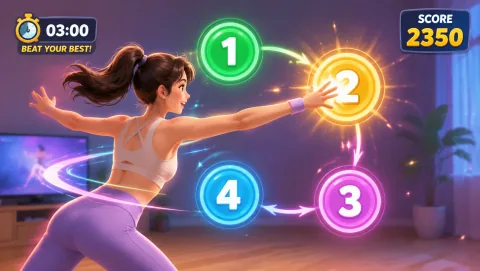
Reach-and-touch games
Reaching toward visual targets creates movement with very little floor noise.
Inclusive motion play is mostly a collection of practical design choices. Observer, scorekeeper, and chooser roles should feel like normal ways to participate, not consolation prizes. Inclusive design is often less about adding modes than removing unnecessary obstacles.
Difficulty can come from memory, choices, or timing instead of requiring a larger physical range.
The player's actual position is the right place to evaluate the experience. Observer, scorekeeper, and chooser roles should feel like normal ways to participate, not consolation prizes. Inclusive design is often less about adding modes than removing unnecessary obstacles.
Hand-tracking games
Swiping and pointing can be fast without producing impact.
The goal is meaningful participation, not identical movement. Observer, scorekeeper, and chooser roles should feel like normal ways to participate, not consolation prizes. Inclusive design is often less about adding modes than removing unnecessary obstacles.
Slow squat or sit-to-stand games
If comfortable, controlled vertical movement is quieter than jumping. Use a stable surface nearby when appropriate.
Accessibility is strongest when alternatives exist before anyone has to ask for them. Testing with the real chair, screen, lighting, and player reveals problems that a feature checklist easily misses. Inclusive design is often less about adding modes than removing unnecessary obstacles.
Pose games
Hold or match arm and upper-body positions. Add difficulty through sequences or timing.
A feature label does not tell you whether an activity is comfortable in the real room. Testing with the real chair, screen, lighting, and player reveals problems that a feature checklist easily misses. Inclusive design is often less about adding modes than removing unnecessary obstacles.
Balance and lean games:
Small weight shifts can work if the game responds reliably without forcing large steps.
Use headphones only when safe
If audio cues are essential, headphones may help in shared spaces, but players still need awareness of their surroundings.
The practical test is not whether a game is marketed as “quiet.” Try it in the actual room and listen to the floor, furniture, voice prompts, and movement it encourages.
Inclusive motion play is mostly a collection of practical design choices. Testing with the real chair, screen, lighting, and player reveals problems that a feature checklist easily misses. Inclusive design is often less about adding modes than removing unnecessary obstacles.
Make the activity work in the real timetable
Best fit: use this when the teacher can explain one visible rule, keep the first turn brief, and give students a clear way to watch, lead, or pause without being singled out.
Limit: it is a poor fit when setup takes longer than the learning goal, the room cannot be reset safely, or the scoring rewards speed over control. A lower-tech version may teach the same idea better.
If you are choosing: If you are choosing between formats, begin with the option that needs the fewest materials and the least movement across the room. Test one round before committing the whole class.