Not every brain break should make the room louder. In a small classroom—or a class next to another lesson—you may need students to reset without running, jumping, or raising their voices.
A classroom game earns its place when it fits the room, the clock, and the lesson. The best formats can be repeated with new prompts so students know how to play before the teacher has finished explaining. The teacher should finish with more control of the room, not less.
Activities that work in a real classroom
Silent mirror
Students work in pairs. One leads slow movements; the other mirrors. Switch after 30 seconds.
Set the finish signal before the first movement so students know exactly what happens when the round ends.
Balance sequence
Stand beside the desk and move through a few stable positions: feet together, heel-to-toe, one foot lightly raised, arms overhead. Students can keep a hand on the desk if needed.
For school use, I would always think about the ending before starting the activity. The best formats can be repeated with new prompts so students know how to play before the teacher has finished explaining. The teacher should finish with more control of the room, not less.
Visual scan
Ask students to silently find:
- five blue objects;
- three circles;
- something beginning with a chosen letter;
- two objects that have changed position since morning.
In a classroom, an activity has to work for the teacher as well as the students. Rules should be fast to explain, participation should not create a long queue, and the room needs a clear route back to learning. A small amount of structure makes the activity much easier to reuse.
Slow-motion movement
Students perform a simple action—reach, turn, sit, stand—as slowly and smoothly as possible.
The most important classroom detail is often the transition nobody puts in the title. Rules should be fast to explain, participation should not create a long queue, and the room needs a clear route back to learning. A small amount of structure makes the activity much easier to reuse.
Pattern copy
Teacher taps a quiet rhythm on the desk. Students repeat using fingertips or palms.
Teachers benefit more from reliable formats than from endless novelty. Rules should be fast to explain, participation should not create a long queue, and the room needs a clear route back to learning. A small amount of structure makes the activity much easier to reuse.
Look near, look far
After screen or reading work, shift attention to a distant object, then something near. Repeat several times without turning it into an eye exercise prescription; the purpose is simply to change the visual task.
One-minute sketch
Give a small prompt: “draw an object using only triangles” or “draw today’s weather without drawing a cloud.”
Three-notice reset
Students identify three sounds, three colors, or three textures. They can write them rather than say them aloud.
Quiet webcam activity
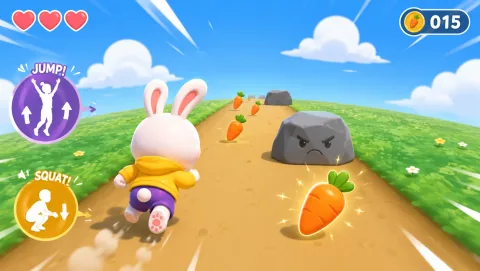
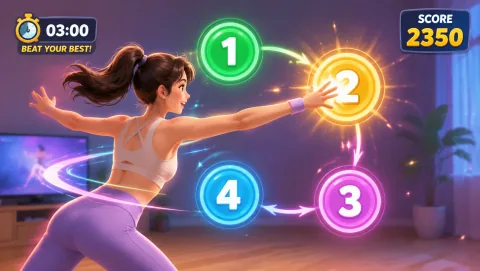
If you use a motion game, choose hand-based or low-movement interaction rather than jumping or stomping. In MovePlay, hand- or reach-focused games are more suitable for shared walls than high-impact titles.
Quiet does not have to mean motionless. Slow mirror movements, balance, breathing with a visual cue, or silent sequencing can change posture and attention without raising the room's volume.
What makes it usable for a teacher
A classroom game earns its place when it fits the room, the clock, and the lesson. Rules should be fast to explain, participation should not create a long queue, and the room needs a clear route back to learning. A small amount of structure makes the activity much easier to reuse.
Keep the break truly short:
Quiet breaks work best when students know they do not need to perform or discuss afterward. Two or three minutes can be enough to change posture and attention before the next task.
One thing I would not ignore
For school use, I would always think about the ending before starting the activity. Rules should be fast to explain, participation should not create a long queue, and the room needs a clear route back to learning. A small amount of structure makes the activity much easier to reuse.
The best break has an exit
In a classroom, an activity has to work for the teacher as well as the students. A final freeze, countdown, seated cue, or retrieval question can make a two-minute break genuinely useful instead of creating five minutes of recovery. A small amount of structure makes the activity much easier to reuse.
Make the activity work in the real timetable
Best fit: use this when the teacher can explain one visible rule, keep the first turn brief, and give students a clear way to watch, lead, or pause without being singled out.
Limit: it is a poor fit when setup takes longer than the learning goal, the room cannot be reset safely, or the scoring rewards speed over control. A lower-tech version may teach the same idea better.
If you are choosing: If you are choosing between formats, begin with the option that needs the fewest materials and the least movement across the room. Test one round before committing the whole class.