Walk-up booth games need to be understandable before the visitor fully stops. If staff must explain controls for two minutes, the experience is too heavy for passing exhibition traffic.
A successful activity creates a queue, which means the queue has to be designed too. Spectators should be able to understand what is happening quickly so watching one round naturally recruits the next participant. That is the difference between a demo and something a venue can actually operate.
Reaction challenge
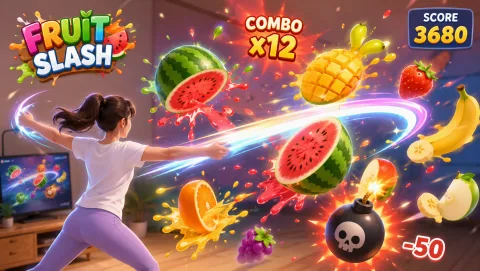
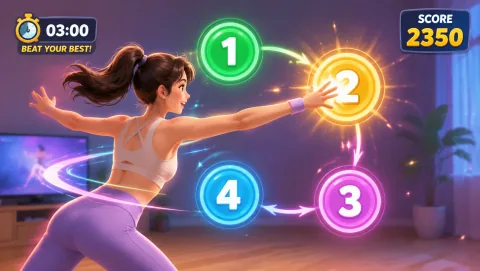
Hit or reach toward as many targets as possible in 20–30 seconds. The score is obvious and spectators understand it immediately.
B2B use changes the definition of a good game. Spectators should be able to understand what is happening quickly so watching one round naturally recruits the next participant. That is the difference between a demo and something a venue can actually operate.
Staff time and reset time are part of product quality in a live environment. Spectators should be able to understand what is happening quickly so watching one round naturally recruits the next participant. That is the difference between a demo and something a venue can actually operate.
One-question prediction
Let visitors choose an answer, category, or outcome and reveal the result instantly.
Public and commercial activities have to survive operational reality. A two-minute experience with a fast reset may outperform a deeper game that serves only a handful of people per hour. That is the difference between a demo and something a venue can actually operate.
At a booth or venue, the game is only one part of the experience. A two-minute experience with a fast reset may outperform a deeper game that serves only a handful of people per hour. That is the difference between a demo and something a venue can actually operate.
Spin-and-do challenge
A digital or physical wheel selects a quick task, product question, or movement prompt.
A successful activity creates a queue, which means the queue has to be designed too. A two-minute experience with a fast reset may outperform a deeper game that serves only a handful of people per hour. That is the difference between a demo and something a venue can actually operate.
Pose or gesture match
A camera-based game asks the visitor to copy one simple shape. This creates visible action without requiring a controller.
B2B use changes the definition of a good game. A two-minute experience with a fast reset may outperform a deeper game that serves only a handful of people per hour. That is the difference between a demo and something a venue can actually operate.
Fast product sorting:
Visitors drag, point, or choose between product use cases, myths, or categories.
Beat-the-score:
Keep one visible daily high score. A simple target gives repeat visitors and colleagues a reason to compete.
Operational rules
Keep the round short, the reset automatic, the queue clear, and the prize optional. Avoid personal data collection before the person has received any value.
A good walk-up game is closer to a vending machine than a workshop: the interaction should reveal itself quickly.
Staff time and reset time are part of product quality in a live environment. A two-minute experience with a fast reset may outperform a deeper game that serves only a handful of people per hour. That is the difference between a demo and something a venue can actually operate.
Keep the social pressure lower than the benefit
Best fit: this is useful when people can join for a short reset, understand the invitation immediately, and leave without having to explain why they are sitting out.
Limit: it is a poor choice when participation is treated as a performance, the activity competes with a serious meeting, or colleagues have very different comfort levels with cameras and movement.
If you are choosing: If you are choosing between ideas, prefer a short optional round with a personal target over a public leaderboard. The goal is an easier break, not another workplace metric.