When you have been sitting for hours, a movement game can be more appealing than telling yourself to “take an exercise break.” The best options use simple actions and take less than ten minutes.
For adults, the hardest part is often starting rather than knowing what movement is available. Leaving room for ten-minute days makes consistency easier and does not stop you from doing more when you have momentum. The aim is to make movement easier to return to.
Low-friction ways to move
Reaction reach
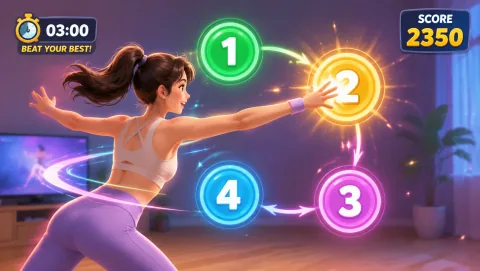
Place four imaginary targets around you. Use a random number generator or a friend to call 1–4 and reach to the matching target.
Attach it to a natural break in the day so you do not need a second decision about when to begin.
Step-and-freeze
Move in place—march, side step, knee lift—then freeze whenever a timer or sound stops.
If the format is enjoyable, resist the urge to optimize it immediately into a complicated program.
Balance score
Time a comfortable balance on each side. Try to improve the total without turning it into an all-out test.
Use effort that feels appropriate today; tomorrow's repeat matters more than today's heroic session.
Movement memory
Create a sequence of four actions. Repeat it and add one each round.
A score or streak can be motivating, but it should not make you ignore discomfort or poor movement quality.
One-song challenge
Pick a song and keep moving until it ends. Alternate easy and faster movement based on how you feel.
A sustainable active routine usually has a very low-friction version. Leaving room for ten-minute days makes consistency easier and does not stop you from doing more when you have momentum. The aim is to make movement easier to return to.
Webcam reaction game
If you prefer a screen-based challenge, a few rounds of Reaction, Whack A Mole, or another motion game can provide a clear score and stopping point. MovePlay works from a browser webcam, which makes it convenient for a home desk setup.
It helps to judge movement by repeatability before ambition. Leaving room for ten-minute days makes consistency easier and does not stop you from doing more when you have momentum. The aim is to make movement easier to return to.
Quiet apartment option
Use reaches, calf raises, side steps, controlled squats, and upper-body movement. You do not need jumping to change posture and elevate effort modestly.
Do not treat discomfort as a challenge
If sitting has produced pain, numbness, dizziness, or another concerning symptom, a game is not the right response to diagnose or push through it. Use ordinary judgment and seek medical advice when appropriate.
For routine desk stiffness, the main value of a movement game is behavioral: it creates a reason to stand up now rather than after one more email.
How to make it repeatable:
The useful question is what you would still do on a busy or low-energy day. Leaving room for ten-minute days makes consistency easier and does not stop you from doing more when you have momentum. The aim is to make movement easier to return to.
One thing I would not ignore:
Many adults need a smaller commitment, not a more sophisticated workout. Leaving room for ten-minute days makes consistency easier and does not stop you from doing more when you have momentum. The aim is to make movement easier to return to.
Short and repeatable wins:
For adults, the hardest part is often starting rather than knowing what movement is available. The format should reduce the friction around movement instead of adding new equipment, guilt, or preparation. The aim is to make movement easier to return to.
Judge the format by the device and the room
Best fit: start here when the device is already available, the camera view is understandable, and the activity can be completed without moving furniture or sharing more video than necessary.
Limit: it is a weaker choice when the connection is unstable, the frame is crowded, the light makes tracking unreliable, or the player needs a movement the camera cannot read consistently.
If you are choosing: If you are choosing between a digital and an offline version, test the first cue before choosing the game. Use the offline option when it gives clearer feedback or a more comfortable way to participate.