The best pre-dinner family games are short enough to end when food is ready. Avoid anything with a long setup, complicated scoring, or a child who will insist the game cannot possibly stop in the middle.
These all work in roughly five to ten minutes.
Family play works best when it leaves room for different ages and different levels of enthusiasm. The strongest formats let people drift in and out without needing the event to stop and restart. That flexibility is usually what makes a family game worth bringing back.
Formats that work well for families
Category race
Pick a category—animals, foods, cities, movies—and go around the room naming one item each. Anyone who repeats or takes too long loses that round.
Mixed-age groups usually work better when the same game can be played for a personal best as well as for a winner.
One-minute drawing
Choose a prompt and give everyone 60 seconds. The drawings do not need to be good; that is usually the point.
If one person is hesitant, let them watch a round or take a scorekeeping role before asking them to perform.
Copy the sequence
One person starts with a clap, reach, or simple movement. Each player repeats the sequence and adds one action.
A family game is easier to repeat when setup takes less time than explaining whose turn it is.
Sock toss
Use a laundry basket as the target and rolled socks as the balls. Give each person five throws.
Mixed-age groups expose weaknesses in a game very quickly. The strongest formats let people drift in and out without needing the event to stop and restart. That flexibility is usually what makes a family game worth bringing back.
Quick reaction round
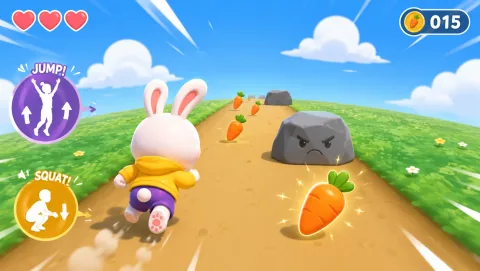
Use verbal cues—left, right, high, low, freeze—or play one short round of a reaction game. If your family already uses MovePlay, a Reaction or Whack A Mole round has a natural stopping point and takes little time.
Keep turns short enough that the people watching remain part of the moment instead of starting a separate conversation.
Five-question family quiz
One person asks five questions about family members, the day, school, or a favorite topic. Switch quizmaster the next evening.
Slow-motion race
Choose a short route. The last person to cross the finish line without stopping wins.
How to keep more people involved:
A family game is partly about the people who are not holding the controller. The strongest formats let people drift in and out without needing the event to stop and restart. That flexibility is usually what makes a family game worth bringing back.
Why this time slot needs a clean ending
Dinner is already the next activity. The game should not compete with it.
Say “two rounds” or “everyone gets five throws” before starting. A fixed ending makes the transition easier than stopping because someone in the kitchen suddenly shouts that food is ready.
Pre-dinner games are most useful as a repeatable family habit: small, easy, and not important enough to cause an argument when they end.
One thing I would not ignore:
The social rhythm matters as much as the rules. The strongest formats let people drift in and out without needing the event to stop and restart. That flexibility is usually what makes a family game worth bringing back.
Keep the whole room in mind
For a household or gathering, I would judge the game by the whole room rather than the most competitive player. The strongest formats let people drift in and out without needing the event to stop and restart. That flexibility is usually what makes a family game worth bringing back.
Make the activity work in the real timetable
Best fit: use this when the teacher can explain one visible rule, keep the first turn brief, and give students a clear way to watch, lead, or pause without being singled out.
Limit: it is a poor fit when setup takes longer than the learning goal, the room cannot be reset safely, or the scoring rewards speed over control. A lower-tech version may teach the same idea better.
If you are choosing: If you are choosing between formats, begin with the option that needs the fewest materials and the least movement across the room. Test one round before committing the whole class.