A webcam can add one interactive station to a PE circuit without replacing the rest of the lesson. This is often a better fit than trying to make an entire class use one camera at once.
For school use, I would always think about the ending before starting the activity. If the projector, camera, or permissions need live troubleshooting, the activity is not low-prep that day. That is what turns a fun idea into a classroom tool.
Formats that work under PE constraints
Reaction station
Use a target-based camera game. One student plays while a partner counts hits or records the score. Switch after one or two minutes.
In a classroom, an activity has to work for the teacher as well as the students. Movement should support the teaching goal or the reset the teacher actually needs, not exist just because technology makes it possible. That is what turns a fun idea into a classroom tool.
Squat-and-dodge station
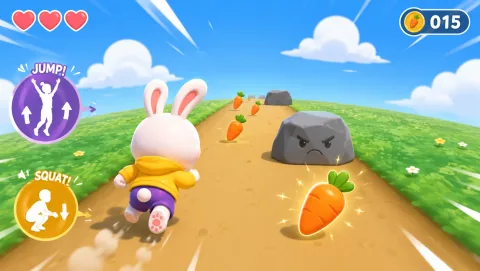
Choose a game where lower-body movement controls the action. Make sure the camera can see the student’s full body and the floor area is clear.
MovePlay’s SquatPacman is an example of a game that uses squat-and-stand timing as part of play.
Offer an easier movement range without making it feel like a public 'easy version.'
Upper-body station
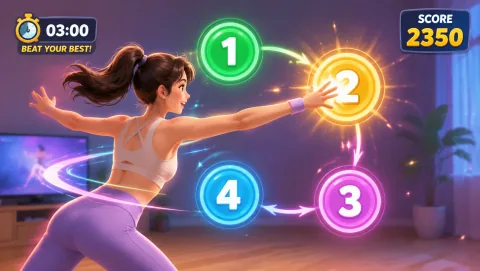
Use reaching or swiping games when the space is tighter. These are easier to place near a wall or in a classroom corner than jumping games.
Use the digital feedback as one source of information, not as a substitute for teacher observation.
Pose station
Students copy on-screen shapes or silhouettes. Add a partner observer who checks whether the pose is recognizable.
Keep a non-digital station ready so a browser or camera problem does not stop the lesson.
Hand-tracking station
For lower-intensity rotations, use hand or gesture games that emphasize precision instead of cardio.
Give the station a clear zone, time limit, and reset instruction before the first student starts.
Build the rest of the circuit offline
A five-station lesson might include:
- webcam reaction;
- balance;
- throwing accuracy;
- mobility;
- rhythm or footwork.
The camera is one source of feedback, not the whole program.
If one student is active and five are waiting, change the rotation before adding more features to the game.
Operational checklist
Before class:
- test the browser and camera;
- mark the play zone;
- decide turn length;
- choose whether scores matter;
- prepare a non-camera fallback;
- confirm privacy and school device policies.
What makes it work in PE
The most important classroom detail is often the transition nobody puts in the title. Movement should support the teaching goal or the reset the teacher actually needs, not exist just because technology makes it possible. That is what turns a fun idea into a classroom tool.
Do not use the webcam for assessment it was not designed to provide
A consumer movement game can create engagement and feedback, but it is not automatically a valid tool for grading technique, diagnosing movement problems, or measuring fitness outcomes.
Use the station for play, reaction, movement practice, and variety. Keep professional assessment separate.
One thing I would not ignore:
Teachers benefit more from reliable formats than from endless novelty. Movement should support the teaching goal or the reset the teacher actually needs, not exist just because technology makes it possible. That is what turns a fun idea into a classroom tool.
Keep PE broader than the screen
A classroom game earns its place when it fits the room, the clock, and the lesson. Movement should support the teaching goal or the reset the teacher actually needs, not exist just because technology makes it possible. That is what turns a fun idea into a classroom tool.
Make the activity work in the real timetable
Best fit: use this when the teacher can explain one visible rule, keep the first turn brief, and give students a clear way to watch, lead, or pause without being singled out.
Limit: it is a poor fit when setup takes longer than the learning goal, the room cannot be reset safely, or the scoring rewards speed over control. A lower-tech version may teach the same idea better.
If you are choosing: If you are choosing between formats, begin with the option that needs the fewest materials and the least movement across the room. Test one round before committing the whole class.