Movement is an effective way to make patterns visible because students can see and feel what repeats, changes, or comes next.
These games work in early math, music, coding concepts, memory practice, and general classroom breaks.
In a classroom, an activity has to work for the teacher as well as the students. Movement should support the teaching goal or the reset the teacher actually needs, not exist just because technology makes it possible. A small amount of structure makes the activity much easier to reuse.
Activities to use in the lesson
Copy the pattern
Start with a short sequence such as clap-clap-reach. Students copy it exactly.
Change one element and ask what changed.
The most important classroom detail is often the transition nobody puts in the title. Movement should support the teaching goal or the reset the teacher actually needs, not exist just because technology makes it possible. A small amount of structure makes the activity much easier to reuse.
Continue the pattern
Use movements to build AB, AAB, ABB, or ABC patterns. Students perform the next action without being told.
Accuracy in the content should matter more than speed of movement.
Find the error
Perform a repeated sequence but make one deliberate mistake. Students identify where the pattern broke.
Use this for review or retrieval before using it for brand-new material that already demands a lot of attention.
Growing sequence
Start with one movement and add another each round. This becomes a memory game as well as a sequence task.
If students remember the action but not the concept, simplify the movement and strengthen the prompt.
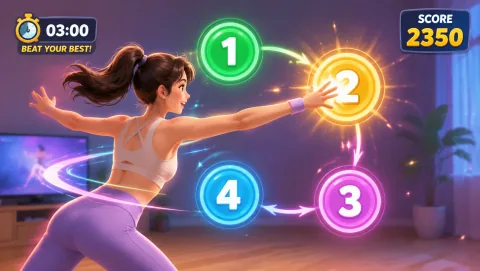
Number-to-movement code
Assign movements to numbers or symbols. Display a string such as 1-2-2-3 and have students “run” the code physically.
Teachers benefit more from reliable formats than from endless novelty. Movement should support the teaching goal or the reset the teacher actually needs, not exist just because technology makes it possible. A small amount of structure makes the activity much easier to reuse.
Partner design
One student creates a pattern; the partner performs it and names the structure.
Keep the physical rule simple enough that working memory stays available for the subject itself.
Rhythm patterns
Use claps, taps, steps, and pauses. Ask students to translate the rhythm into visual symbols afterward.
Projected sequence challenge
Show arrows, colors, or icons on screen and have students perform the sequence. A webcam or motion-tracking station can make the screen respond to the movement, but it is not required.
Connect movement back to abstraction
After students perform a pattern, represent it with letters, numbers, shapes, or code-like symbols.
The movement is useful because it makes the structure concrete. The learning becomes stronger when students can move between the physical pattern and its abstract representation.
How to keep the learning central
A classroom game earns its place when it fits the room, the clock, and the lesson. Movement should support the teaching goal or the reset the teacher actually needs, not exist just because technology makes it possible. A small amount of structure makes the activity much easier to reuse.
One thing I would not ignore
For school use, I would always think about the ending before starting the activity. Movement should support the teaching goal or the reset the teacher actually needs, not exist just because technology makes it possible. A small amount of structure makes the activity much easier to reuse.
Keep the learning visible
In a classroom, an activity has to work for the teacher as well as the students. The best formats can be repeated with new prompts so students know how to play before the teacher has finished explaining. A small amount of structure makes the activity much easier to reuse.
Make the activity work in the real timetable
Best fit: use this when the teacher can explain one visible rule, keep the first turn brief, and give students a clear way to watch, lead, or pause without being singled out.
Limit: it is a poor fit when setup takes longer than the learning goal, the room cannot be reset safely, or the scoring rewards speed over control. A lower-tech version may teach the same idea better.
If you are choosing: If you are choosing between formats, begin with the option that needs the fewest materials and the least movement across the room. Test one round before committing the whole class.