A one-screen family game has an underrated advantage: everyone is looking at the same thing. That makes it easier to talk, react, cheer, take turns, and stay part of the same activity.
The best formats do not require everyone to hold a device.
Family play works best when it leaves room for different ages and different levels of enthusiasm. Elimination and long turns can make half the group mentally leave before the game is over. The memorable part is often the shared reaction, not the complexity of the rules.
Formats that work well for families
Trivia games
Use a TV, laptop, or projector to show questions while teams answer aloud or on paper. Mix easy and hard questions so different ages can contribute.
Mixed-age groups usually work better when the same game can be played for a personal best as well as for a winner.
Drawing and guessing
One person draws on screen while others guess. If the app requires phones as controllers, decide whether that still fits your “one-screen” goal; many families prefer a version where only the main display is used.
If one person is hesitant, let them watch a round or take a scorekeeping role before asking them to perform.
Karaoke and music games
A shared screen can show lyrics, rhythm cues, or dance prompts. These work best with families comfortable performing in front of each other.
A family game is easier to repeat when setup takes less time than explaining whose turn it is.
Motion games
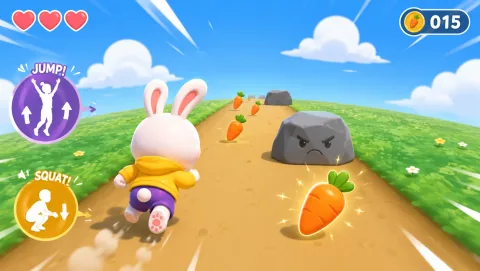
Webcam games can turn one screen into a small activity station. The active player stands in front of the camera; other family members watch, keep score, or wait for the next round.
MovePlay runs in a browser and includes reaction, swipe, pose, and full-body game styles. For family use, short rounds matter more than maximum intensity because turn-taking stays faster.
Mixed-age groups expose weaknesses in a game very quickly. Elimination and long turns can make half the group mentally leave before the game is over. The memorable part is often the shared reaction, not the complexity of the rules.
Cooperative puzzle games
Choose games where the room can discuss solutions together even if one person controls the interface.
This is often better for mixed ages than a fast competitive game.
Keep turns short enough that the people watching remain part of the moment instead of starting a separate conversation.
Family slideshow games
Use your own photos for “guess the year,” “where were we?”, or “who is this baby?” rounds. It is simple and often more engaging across generations than a generic quiz.
How to keep more people involved:
A family game is partly about the people who are not holding the controller. Elimination and long turns can make half the group mentally leave before the game is over. The memorable part is often the shared reaction, not the complexity of the rules.
Make the screen visible, not dominant
Place the display where everyone can see it without forcing the entire group into a straight line. If movement is involved, keep spectators outside the play zone.
One-screen games work because the screen becomes a shared object. They are a useful alternative to family time in which each person is technically together but absorbed in a different device.
One thing I would not ignore:
The social rhythm matters as much as the rules. Elimination and long turns can make half the group mentally leave before the game is over. The memorable part is often the shared reaction, not the complexity of the rules.
What makes the format last
For a household or gathering, I would judge the game by the whole room rather than the most competitive player. Elimination and long turns can make half the group mentally leave before the game is over. The memorable part is often the shared reaction, not the complexity of the rules.
Keep the social pressure lower than the benefit
Best fit: this is useful when people can join for a short reset, understand the invitation immediately, and leave without having to explain why they are sitting out.
Limit: it is a poor choice when participation is treated as a performance, the activity competes with a serious meeting, or colleagues have very different comfort levels with cameras and movement.
If you are choosing: If you are choosing between ideas, prefer a short optional round with a personal target over a public leaderboard. The goal is an easier break, not another workplace metric.