One-handed motion games are useful for more than accessibility. They also work well when a player is holding onto a chair, sharing space, recovering from fatigue, or simply wants a simpler control scheme.
Accessibility is strongest when alternatives exist before anyone has to ask for them. Testing with the real chair, screen, lighting, and player reveals problems that a feature checklist easily misses. That approach produces flexibility people can use without drawing attention to why they need it.
Look for single-hand tracking
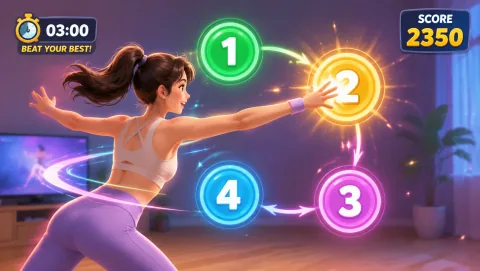
Games built around pointing, swiping, slicing, tapping, or reaching can often be played with one hand if the software does not require symmetrical input.
A feature label does not tell you whether an activity is comfortable in the real room. Testing with the real chair, screen, lighting, and player reveals problems that a feature checklist easily misses. That approach produces flexibility people can use without drawing attention to why they need it.
Inclusive motion play is mostly a collection of practical design choices. Testing with the real chair, screen, lighting, and player reveals problems that a feature checklist easily misses. That approach produces flexibility people can use without drawing attention to why they need it.
Keep targets on the usable side
If possible, choose games or settings that keep targets within a comfortable reach. Crossing far across the body may make a supposedly one-handed game awkward.
Difficulty can come from memory, choices, or timing instead of requiring a larger physical range.
The player's actual position is the right place to evaluate the experience. Testing with the real chair, screen, lighting, and player reveals problems that a feature checklist easily misses. That approach produces flexibility people can use without drawing attention to why they need it.
Camera framing matters
Make sure the active hand stays visible throughout the movement. A camera placed too close can lose the hand near the edge of the frame.
The goal is meaningful participation, not identical movement. Testing with the real chair, screen, lighting, and player reveals problems that a feature checklist easily misses. That approach produces flexibility people can use without drawing attention to why they need it.
Accessibility is strongest when alternatives exist before anyone has to ask for them. Target height, reach distance, camera angle, reaction time, contrast, sound dependence, and role design can all create or remove barriers. Inclusive design is often less about adding modes than removing unnecessary obstacles.
Avoid hidden two-hand requirements:
Menus, calibration screens, or special moves sometimes require both hands even when the main gameplay does not. Test the complete flow before recommending a title as one-handed.
Use one-handed play as a normal option
Do not frame it as a lesser mode. In group play, some people may choose one hand for comfort while others use two.
A genuinely one-handed game should remain understandable, responsive, and enjoyable without forcing the player to compensate elsewhere.
A feature label does not tell you whether an activity is comfortable in the real room. Target height, reach distance, camera angle, reaction time, contrast, sound dependence, and role design can all create or remove barriers. Inclusive design is often less about adding modes than removing unnecessary obstacles.
Judge the format by the device and the room
Best fit: start here when the device is already available, the camera view is understandable, and the activity can be completed without moving furniture or sharing more video than necessary.
Limit: it is a weaker choice when the connection is unstable, the frame is crowded, the light makes tracking unreliable, or the player needs a movement the camera cannot read consistently.
If you are choosing: If you are choosing between a digital and an offline version, test the first cue before choosing the game. Use the offline option when it gives clearer feedback or a more comfortable way to participate.