No-equipment games are useful because the activity can begin before enthusiasm disappears. You do not need cones, beanbags, a balance board, or a box of PE supplies to create a good movement game.
The room and the body are enough.
In a real home, the deciding factor is often not how creative an activity sounds but how quickly a child can understand it. Short rules, a visible finish, and movement that fits the furniture make repeat use much more likely. Good indoor play should fit the household rather than take it over.
Games I would try first
Mirror movement
One player leads; the other copies. Use slow, exaggerated movements first, then speed up. Switch leaders every 30 seconds.
For family use, I would put ease of starting ahead of novelty. Short rules, a visible finish, and movement that fits the furniture make repeat use much more likely. Good indoor play should fit the household rather than take it over.
Command game
Assign actions to simple words: sky = reach, floor = squat, left = step left, right = step right, freeze = stop. Call them in unpredictable order.
The practical test is what happens after the first burst of excitement. Short rules, a visible finish, and movement that fits the furniture make repeat use much more likely. Good indoor play should fit the household rather than take it over.
Movement memory
Start with one action and add another each round. The child repeats the full sequence from the beginning.
I would rather make the timing harder than make the movement bigger. Indoors, challenge does not need more speed across the floor.
Animal moves
Use bear crawl, crab walk, frog jump, penguin steps, or slow elephant stomps. In small spaces, shorten the distance and focus on control.
With children, the room and the timing matter as much as the idea itself. Short rules, a visible finish, and movement that fits the furniture make repeat use much more likely. Good indoor play should fit the household rather than take it over.
Balance challenges
Try one-foot holds, heel-to-toe standing, slow knee lifts, or pose matching. Keep a stable surface nearby for children who need it.
A parent usually needs something that works under ordinary conditions, not a perfect activity day. Short rules, a visible finish, and movement that fits the furniture make repeat use much more likely. Good indoor play should fit the household rather than take it over.
Body-controller games
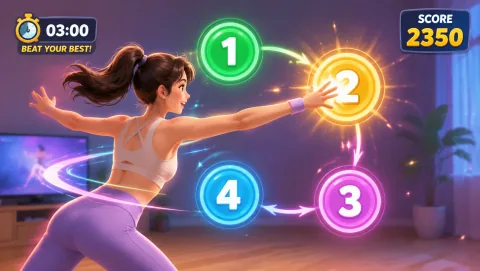
A webcam can act as the input without adding a handheld controller. Browser games such as MovePlay use camera tracking to map movement to actions on screen. Fruit Slash uses sweeping arm movement, Reaction uses reaches toward targets, and SquatPacman uses squatting.
A webcam is still hardware, of course, but it is already built into many laptops and does not require a separate game accessory.
Red light, green light without running
On green, march, side-step, or perform the current movement. On red, freeze. This adapts a familiar game to apartments and classrooms.
Shape calls
Call “tall,” “wide,” “small,” “twisted,” or “one leg.” The child makes a body shape that fits the word.
How I would choose
In a real home, the deciding factor is often not how creative an activity sounds but how quickly a child can understand it. If the child needs constant correction or adult help, the activity is less independent than it looked on the list. Good indoor play should fit the household rather than take it over.
Why no-equipment games are worth keeping
They are easy to use in the moments when equipment-based activities fail: while traveling, in a classroom, in a hotel room, during a school closure, or at home when nobody wants to prepare anything.
The limitation is also clear. A no-equipment game still needs an appropriate space. Choose stepping over running when furniture is close, and avoid jumping where noise, floor conditions, or mobility make it unsuitable.
One thing I would not ignore:
For family use, I would put ease of starting ahead of novelty. If the child needs constant correction or adult help, the activity is less independent than it looked on the list. Good indoor play should fit the household rather than take it over.
A simple way to judge the game:
The aim is not to manufacture exhaustion. Give the energy a job, then make the next transition easier.
Make the activity work in the real timetable
Best fit: use this when the teacher can explain one visible rule, keep the first turn brief, and give students a clear way to watch, lead, or pause without being singled out.
Limit: it is a poor fit when setup takes longer than the learning goal, the room cannot be reset safely, or the scoring rewards speed over control. A lower-tech version may teach the same idea better.
If you are choosing: If you are choosing between formats, begin with the option that needs the fewest materials and the least movement across the room. Test one round before committing the whole class.