Rhythm games give students a clear reason to move together. They can be energetic or quiet, require little equipment, and scale from preschool to older students if the patterns become more complex.
The most important classroom detail is often the transition nobody puts in the title. The best formats can be repeated with new prompts so students know how to play before the teacher has finished explaining. A small amount of structure makes the activity much easier to reuse.
Activities to use in the lesson
Echo clap
Teacher claps a pattern; students echo it. Add rests, syncopation, or body percussion as skill increases.
Keep the physical rule simple enough that working memory stays available for the subject itself.
Step the beat
Students step or march on the steady beat while clapping a separate rhythm. This creates a simple coordination challenge.
Accuracy in the content should matter more than speed of movement.
Freeze on the rest
Play or clap a rhythm with clear pauses. Students move on sound and freeze on silence.
Use this for review or retrieval before using it for brand-new material that already demands a lot of attention.
Body-percussion sequence
Combine clap, snap, tap, stomp, and pat. Use quieter substitutions where noise is an issue.
Teachers benefit more from reliable formats than from endless novelty. The best formats can be repeated with new prompts so students know how to play before the teacher has finished explaining. A small amount of structure makes the activity much easier to reuse.
Rhythm leader
One student creates a four-beat pattern and the class copies. Rotate leaders quickly.
Rhythm already contains timing and repetition, so the body has a natural role. Keep the musical task central; the goal is not to disguise a workout as music class.
Tempo switch
Perform the same movement at slow, medium, and fast tempos. Ask students what changes and what stays constant.
Movement composition
Small groups create an eight-count movement phrase, then teach it to another group.
Visual rhythm
Use icons on a projector to represent actions. Students read the sequence like a simple score.
Motion game option
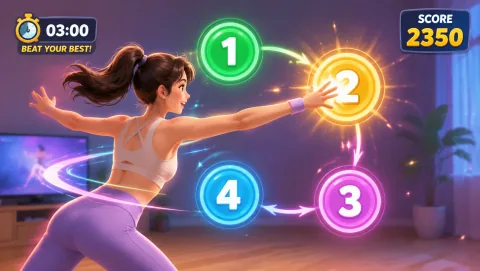
Rhythm-based digital games can add immediate feedback, but the music lesson should not disappear behind the technology. If using a camera or console game, choose one where timing is visible and discuss the beat afterward.
If students remember the action but not the concept, simplify the movement and strengthen the prompt.
Finish with listening
Not every rhythm activity needs maximum movement. After an active round, play a short excerpt and ask students to identify beat, tempo, repetition, or changes in dynamics.
Good rhythm games move naturally between listening and doing. The body becomes another instrument, not just a way to burn energy.
A classroom game earns its place when it fits the room, the clock, and the lesson. The best formats can be repeated with new prompts so students know how to play before the teacher has finished explaining. A small amount of structure makes the activity much easier to reuse.
How to keep the learning central
For school use, I would always think about the ending before starting the activity. The best formats can be repeated with new prompts so students know how to play before the teacher has finished explaining. A small amount of structure makes the activity much easier to reuse.
One thing I would not ignore
In a classroom, an activity has to work for the teacher as well as the students. Rules should be fast to explain, participation should not create a long queue, and the room needs a clear route back to learning. If another teacher can run it tomorrow from a short note, the format is probably strong.
Use movement to clarify
The most important classroom detail is often the transition nobody puts in the title. Rules should be fast to explain, participation should not create a long queue, and the room needs a clear route back to learning. If another teacher can run it tomorrow from a short note, the format is probably strong.
Make the activity work in the real timetable
Best fit: use this when the teacher can explain one visible rule, keep the first turn brief, and give students a clear way to watch, lead, or pause without being singled out.
Limit: it is a poor fit when setup takes longer than the learning goal, the room cannot be reset safely, or the scoring rewards speed over control. A lower-tech version may teach the same idea better.
If you are choosing: If you are choosing between formats, begin with the option that needs the fewest materials and the least movement across the room. Test one round before committing the whole class.