Desk workers often know they should take breaks but ignore reminders that feel generic. A movement game can create a stronger reason to stand because the break has an objective.
For teams, a good energizer is deliberately modest. A one-song reset or 90-second reaction challenge can change the room without becoming another agenda item. Participation is a better success measure here than intensity.
Reaction targets
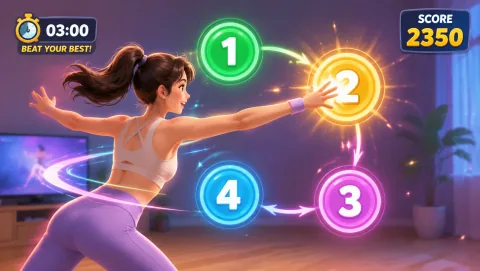
Use four visual targets and respond to a random cue. This works well after long periods of focused keyboard work because the task is simple and physical.
The social design matters as much as the movement itself. A one-song reset or 90-second reaction challenge can change the room without becoming another agenda item. Participation is a better success measure here than intensity.
A break between meetings only works if it respects the context around it. A one-song reset or 90-second reaction challenge can change the room without becoming another agenda item. Participation is a better success measure here than intensity.
Balance score
Time a comfortable balance on each side. Track your own score rather than competing with coworkers.
In professional settings, low pressure usually beats high enthusiasm. A one-song reset or 90-second reaction challenge can change the room without becoming another agenda item. Participation is a better success measure here than intensity.
Movement memory:
Build a short sequence of reaches, steps, and turns. Add one action per round.
One-song challenge
Move until a song ends. This is a natural timer that does not feel like an interval workout.
Workplace movement should fit inside work rather than pretending the office has become a gym. Managers should model participation casually rather than tracking who joins or turning wellbeing into another performance metric. Participation is a better success measure here than intensity.
Webcam game rounds
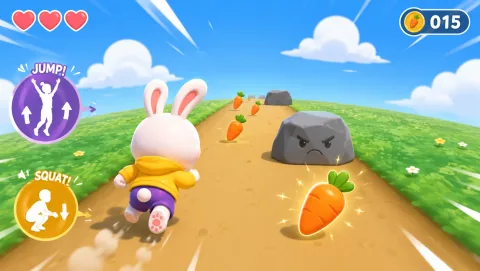
A laptop already has the hardware needed for browser motion games. MovePlay can turn the same device used for coding into a short reaction or movement station.
For a work break, choose fast-loading games with clear round endings. Avoid high-impact titles in offices or apartments where noise matters.
Build-break rule:
If your workflow includes long compiles, model runs, exports, or test suites, use some of those waits as movement cues instead of automatically opening social media.
Walking debug:
When you are stuck on a conceptual problem, take a short walk without the laptop. Explain the problem aloud or record a voice note.
This is not a guaranteed debugging technique, but it changes the context enough to be useful for some problems.
Keep ergonomic claims modest
A movement break can interrupt sitting, but it does not automatically correct posture or solve musculoskeletal pain. Persistent pain deserves proper assessment.
Use games for what they are good at: creating a concrete, repeatable reason to move away from the desk.
For teams, a good energizer is deliberately modest. Managers should model participation casually rather than tracking who joins or turning wellbeing into another performance metric. Participation is a better success measure here than intensity.
Keep the social pressure lower than the benefit
Best fit: this is useful when people can join for a short reset, understand the invitation immediately, and leave without having to explain why they are sitting out.
Limit: it is a poor choice when participation is treated as a performance, the activity competes with a serious meeting, or colleagues have very different comfort levels with cameras and movement.
If you are choosing: If you are choosing between ideas, prefer a short optional round with a personal target over a public leaderboard. The goal is an easier break, not another workplace metric.