Once children reach the later elementary and early middle-school years, many classic “movement break” ideas stop working for a simple reason: the activity feels designed for much younger kids.
Older kids still need movement. They just want more control, challenge, and dignity.
For parents, the more useful distinction is what the child is doing with the screen. A good digital activity earns its place by adding something useful rather than merely occupying time. That framing is more realistic than asking whether screens are simply good or bad.
Games and formats that fit this stage
Reaction games
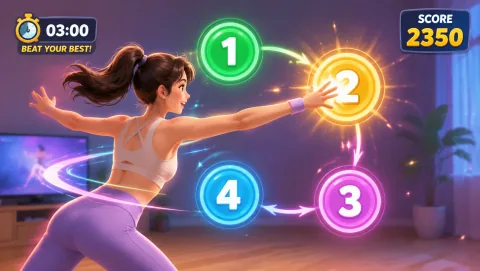
Use fast visual or verbal cues, number sequences, color filtering, or target hitting. These feel closer to arcade games than children’s movement activities.
A webcam reaction game can work well because the player competes against time or a score. MovePlay’s Reaction is one example; other platforms and console games offer similar mechanics.
A screen can support very different behaviors, from passive viewing to creating, talking, solving, or moving. A good digital activity earns its place by adding something useful rather than merely occupying time. That framing is more realistic than asking whether screens are simply good or bad.
Rhythm and music
Let older kids choose the music or game mode. Avoid routines that feel performative if the group is self-conscious.
Individual score challenges can be more comfortable than asking everyone to dance in front of peers.
The label on the app matters less than the behavior it produces. A good digital activity earns its place by adding something useful rather than merely occupying time. That framing is more realistic than asking whether screens are simply good or bad.
Team relays without childish props
Use quick problem-solving plus movement:
- retrieve numbered clues in order;
- complete a movement sequence as a team;
- alternate reaction rounds and combine scores;
- run a three-event indoor challenge.
When evaluating digital play, I would look past the word 'educational' or 'active' on the product page. A good digital activity earns its place by adding something useful rather than merely occupying time. That framing is more realistic than asking whether screens are simply good or bad.
Fitness-style games, lightly framed
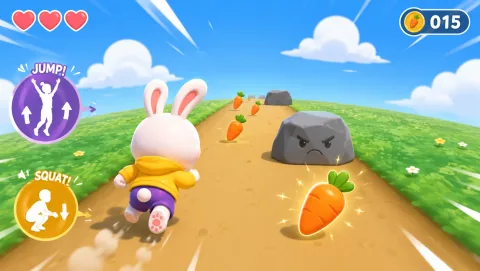
Some older kids are ready for squat, kick, dodge, or interval-based games as long as the presentation feels like sport or gaming rather than a children’s exercise video.
Short rounds are better than announcing a long workout.
Screen time becomes easier to reason about when you stop treating every screen activity as the same thing. Look at choice, effort, stopping points, and what the activity is replacing in the rest of the day. That gives families a more workable rule than counting every minute as identical.
Give them choice
Offer two or three formats and let the group vote. For classrooms, this can be as simple as “reaction, rhythm, or stretch.” For families, let the child pick the first game and an adult pick the second.
For parents, the more useful distinction is what the child is doing with the screen. Look at choice, effort, stopping points, and what the activity is replacing in the rest of the day. That gives families a more workable rule than counting every minute as identical.
What I would watch for
A screen can support very different behaviors, from passive viewing to creating, talking, solving, or moving. Look at choice, effort, stopping points, and what the activity is replacing in the rest of the day. That gives families a more workable rule than counting every minute as identical.
Use challenge language, not preschool language
Replace “wiggle break” with:
- reaction challenge;
- speed round;
- skill test;
- high-score attempt;
- team competition;
- two-minute reset.
The activity can be similar; the framing changes whether the child wants to participate.
Know when not to force participation
Older children are more sensitive to embarrassment. In groups, provide observer, scorekeeper, or caller roles when possible and avoid making a reluctant child perform for a camera.
A movement game succeeds with older kids when it respects them as players. The game should be genuinely challenging, easy to opt into, and free of the tone that says, “This is fun because an adult told you it is.”
One thing I would not ignore:
The label on the app matters less than the behavior it produces. Look at choice, effort, stopping points, and what the activity is replacing in the rest of the day. That gives families a more workable rule than counting every minute as identical.
Let the child make the final call
When evaluating digital play, I would look past the word 'educational' or 'active' on the product page. Look at choice, effort, stopping points, and what the activity is replacing in the rest of the day. That gives families a more workable rule than counting every minute as identical.
Make the activity work in the real timetable
Best fit: use this when the teacher can explain one visible rule, keep the first turn brief, and give students a clear way to watch, lead, or pause without being singled out.
Limit: it is a poor fit when setup takes longer than the learning goal, the room cannot be reset safely, or the scoring rewards speed over control. A lower-tech version may teach the same idea better.
If you are choosing: If you are choosing between formats, begin with the option that needs the fewest materials and the least movement across the room. Test one round before committing the whole class.