A classroom does not need an empty floor for students to move. When desks stay where they are, the safest options keep each student inside a small personal space.
The most important classroom detail is often the transition nobody puts in the title. A final freeze, countdown, seated cue, or retrieval question can make a two-minute break genuinely useful instead of creating five minutes of recovery. A small amount of structure makes the activity much easier to reuse.
Activities that work in a real classroom
Reach in four directions
Students stand behind or beside the desk and reach high, low, left, and right on cue.
Add cross-body reaches for more variety.
Set the finish signal before the first movement so students know exactly what happens when the round ends.
March in place
Use 30–60 seconds of marching, then change arm positions or tempo. Keep feet under control in tightly packed rooms.
Teachers benefit more from reliable formats than from endless novelty. A final freeze, countdown, seated cue, or retrieval question can make a two-minute break genuinely useful instead of creating five minutes of recovery. A small amount of structure makes the activity much easier to reuse.
Sit-to-stand pattern
Where appropriate, students alternate standing and sitting on cue. Avoid speed competitions; chairs and crowded desks make that unnecessary.
A classroom game earns its place when it fits the room, the clock, and the lesson. A final freeze, countdown, seated cue, or retrieval question can make a two-minute break genuinely useful instead of creating five minutes of recovery. A small amount of structure makes the activity much easier to reuse.
Desk-supported balance
Use the desk lightly for support while students shift weight, lift one heel, or try a short single-leg balance.
For school use, I would always think about the ending before starting the activity. A final freeze, countdown, seated cue, or retrieval question can make a two-minute break genuinely useful instead of creating five minutes of recovery. A small amount of structure makes the activity much easier to reuse.
Upper-body mirror
One student or teacher leads arm, shoulder, and torso movements while everyone copies from their own space.
In a classroom, an activity has to work for the teacher as well as the students. If the projector, camera, or permissions need live troubleshooting, the activity is not low-prep that day. A small amount of structure makes the activity much easier to reuse.
Movement memory
Build a sequence of gestures rather than traveling movements: clap, reach, turn, squat slightly, touch shoulders, freeze.
Visual reaction
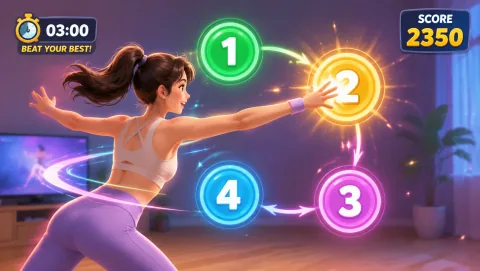
Project arrows or targets. Students respond with a reach or point instead of moving across the room.
A webcam game can be adapted to the same principle if one player uses a small play zone while classmates mirror from their desks.
Chair-based option
Some students may prefer or need to remain seated. Arm reaches, torso turns, rhythm taps, and hand patterns can keep them included in the same activity.
What makes it usable for a teacher
The most important classroom detail is often the transition nobody puts in the title. If the projector, camera, or permissions need live troubleshooting, the activity is not low-prep that day. A small amount of structure makes the activity much easier to reuse.
Define the personal space rule
Before starting, tell students that feet stay within their own desk zone unless a specific move says otherwise.
The purpose of a classroom movement break is not maximum activity. It is a safe change of posture and attention that fits the room you actually teach in.
One thing I would not ignore:
Teachers benefit more from reliable formats than from endless novelty. If the projector, camera, or permissions need live troubleshooting, the activity is not low-prep that day. A small amount of structure makes the activity much easier to reuse.
Use what you can recover from:
A classroom game earns its place when it fits the room, the clock, and the lesson. If the projector, camera, or permissions need live troubleshooting, the activity is not low-prep that day. A small amount of structure makes the activity much easier to reuse.
Make the activity work in the real timetable
Best fit: use this when the teacher can explain one visible rule, keep the first turn brief, and give students a clear way to watch, lead, or pause without being singled out.
Limit: it is a poor fit when setup takes longer than the learning goal, the room cannot be reset safely, or the scoring rewards speed over control. A lower-tech version may teach the same idea better.
If you are choosing: If you are choosing between formats, begin with the option that needs the fewest materials and the least movement across the room. Test one round before committing the whole class.