Motion games become more usable when challenge does not depend on every player reaching the same height, depth, or distance. Adjustable movement range helps children, older adults, seated players, beginners, and people playing in smaller spaces.
Inclusive motion play is mostly a collection of practical design choices. Difficulty can grow through memory, sequencing, precision, or choice rather than demanding larger and faster movements. The format succeeds when nobody has to justify how they take part.
Calibrate a comfortable range
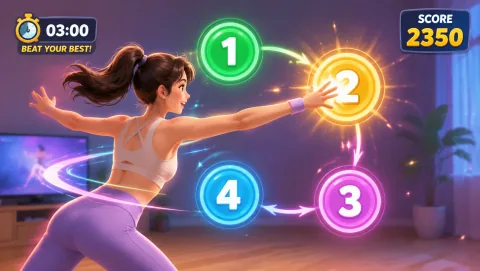
Instead of assuming a fixed “full reach,” a game can observe or ask the player to set comfortable left, right, high, and low positions.
Targets can then stay inside that envelope.
The player's actual position is the right place to evaluate the experience. Difficulty can grow through memory, sequencing, precision, or choice rather than demanding larger and faster movements. The format succeeds when nobody has to justify how they take part.
The goal is meaningful participation, not identical movement. Difficulty can grow through memory, sequencing, precision, or choice rather than demanding larger and faster movements. The format succeeds when nobody has to justify how they take part.
Scale difficulty through decisions
Faster choices, longer sequences, distractors, memory, and accuracy can make a game harder without demanding larger movement.
Difficulty can come from memory, choices, or timing instead of requiring a larger physical range.
Accessibility is strongest when alternatives exist before anyone has to ask for them. A seated version only works if the targets, framing, and controls are genuinely reachable from a chair. The format succeeds when nobody has to justify how they take part.
Let seated and standing modes use the same goal
A reaching game can work in both positions if target placement adapts. The experience should not treat the seated mode as a completely different activity unless the mechanics truly require it.
A feature label does not tell you whether an activity is comfortable in the real room. A seated version only works if the targets, framing, and controls are genuinely reachable from a chair. The format succeeds when nobody has to justify how they take part.
Avoid form judgment unless the product is designed for it:
A casual game should not label a smaller squat or shorter reach “wrong” unless it has a validated reason to measure form.
Design the UI around the calibrated range:
Visual target zones should make sense relative to the player’s available movement. Do not show unreachable targets and then silently ignore them.
Test with real variation
Adjustability needs user testing across body sizes, mobility levels, camera positions, and rooms. A settings menu is not enough.
Flexible movement range changes the question from “Can the player perform the game’s ideal motion?” to “Can the game adapt to a safe, meaningful motion the player can actually use?”
Inclusive motion play is mostly a collection of practical design choices. A seated version only works if the targets, framing, and controls are genuinely reachable from a chair. The format succeeds when nobody has to justify how they take part.
Choose it for the group in front of you
Best fit: this works when the ages and confidence levels can share one simple goal, with an adult able to explain the first round and step in if the room loses focus.
Limit: it is a weaker choice when children are tired, the ages are far apart, or one person is expected to perform in front of everyone. A quieter role or a shorter round may be the better answer.
If you are choosing: start with the smallest version that can succeed in the available space. Add speed, scoring, or competition only after the group understands the basic action.