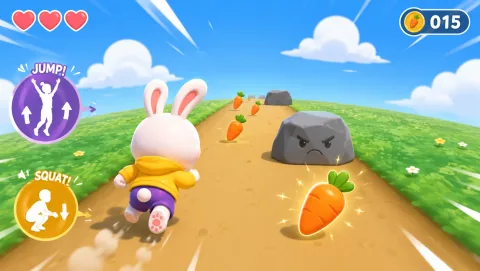
Children ages seven to nine can handle more complex motion games than younger kids, but they still benefit from fast starts and clear feedback. This is a strong age for reaction challenges, high scores, rhythm, movement sequences, and games that combine more than one action.
For parents, the more useful distinction is what the child is doing with the screen. Look at choice, effort, stopping points, and what the activity is replacing in the rest of the day. That framing is more realistic than asking whether screens are simply good or bad.
Games and formats that fit this stage
Reaction games
At this age, children can respond to rules beyond “hit the target.” Add number order, color filtering, left-right switching, or changing speed.
Browser games such as MovePlay’s Reaction can support repeated attempts because the child can see whether the next score improves.
A screen can support very different behaviors, from passive viewing to creating, talking, solving, or moving. Look at choice, effort, stopping points, and what the activity is replacing in the rest of the day. That framing is more realistic than asking whether screens are simply good or bad.
Squat, dodge, and jump games
Full-body games become more interesting when the child has to choose the correct movement rather than repeat one action mindlessly.
Look for combinations such as:
- squat vs stand;
- dodge left vs right;
- jump vs duck;
- move vs freeze.
Make sure the room supports the movement before choosing the game.
The label on the app matters less than the behavior it produces. Look at choice, effort, stopping points, and what the activity is replacing in the rest of the day. That framing is more realistic than asking whether screens are simply good or bad.
Rhythm and timing
Clap patterns, dance games, stomp sequences, and beat-matching are good for children who enjoy music and repetition.
Give them a chance to create patterns for siblings or adults to copy.
When evaluating digital play, I would look past the word 'educational' or 'active' on the product page. Look at choice, effort, stopping points, and what the activity is replacing in the rest of the day. That framing is more realistic than asking whether screens are simply good or bad.
Pose and social games
Seven- to nine-year-olds often enjoy games that are funny to watch as well as play. Pose matching, silly challenge rounds, and turn-taking games work well for siblings and family gatherings.
Screen time becomes easier to reason about when you stop treating every screen activity as the same thing. A finite round is easier to manage than an endless feed, and active input is different from simply letting a video run. That framing is more realistic than asking whether screens are simply good or bad.
Build small competitions
Competition can add replay value if it stays short.
Try:
- best of three rounds;
- beat your own score;
- adult vs child;
- sibling team score;
- most improved player rather than only highest score.
For parents, the more useful distinction is what the child is doing with the screen. A finite round is easier to manage than an endless feed, and active input is different from simply letting a video run. That framing is more realistic than asking whether screens are simply good or bad.
Let them manage more of the session
Children in this range can increasingly choose the next game, track scores, run a timer, or explain the rules to another player.
That ownership can matter more than adding another difficulty level.
A screen can support very different behaviors, from passive viewing to creating, talking, solving, or moving. A finite round is easier to manage than an endless feed, and active input is different from simply letting a video run. That framing is more realistic than asking whether screens are simply good or bad.
What I would watch for
The label on the app matters less than the behavior it produces. A finite round is easier to manage than an endless feed, and active input is different from simply letting a video run. That framing is more realistic than asking whether screens are simply good or bad.
Avoid “little kid” framing
Even at seven or eight, some children reject activities that look preschool-oriented. Use neutral or game-like language—challenge, reaction, score, level—rather than constantly calling everything a “movement break.”
A good motion game for this age should still work as a game first. If the child only plays because an adult keeps reminding them it is healthy, replay is unlikely.
One thing I would not ignore
When evaluating digital play, I would look past the word 'educational' or 'active' on the product page. A finite round is easier to manage than an endless feed, and active input is different from simply letting a video run. That framing is more realistic than asking whether screens are simply good or bad.
What replay tells you
Screen time becomes easier to reason about when you stop treating every screen activity as the same thing. The same device can be part of a creative hour or part of a passive one; context decides which it is. That framing is more realistic than asking whether screens are simply good or bad.
Make the activity work in the real timetable
Best fit: use this when the teacher can explain one visible rule, keep the first turn brief, and give students a clear way to watch, lead, or pause without being singled out.
Limit: it is a poor fit when setup takes longer than the learning goal, the room cannot be reset safely, or the scoring rewards speed over control. A lower-tech version may teach the same idea better.
If you are choosing: If you are choosing between formats, begin with the option that needs the fewest materials and the least movement across the room. Test one round before committing the whole class.