Math movement games are most useful when the movement represents a mathematical idea or turns practice into a fast-response task. The activity should reinforce the concept, not distract from it.
In a classroom, an activity has to work for the teacher as well as the students. Rules should be fast to explain, participation should not create a long queue, and the room needs a clear route back to learning. The teacher should finish with more control of the room, not less.
Activities to use in the lesson
Human number line
Assign a line across the room—or an imaginary line beside desks—as a number line. Students step left or right to solve addition, subtraction, integers, or estimation questions.
Keep the physical rule simple enough that working memory stays available for the subject itself.
Answer positions
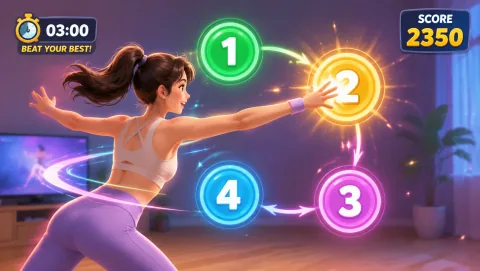
Give four answer choices and map them to four directions or movements. Students respond physically, then explain the reasoning.
Accuracy in the content should matter more than speed of movement.
Shape poses
Students use arms or whole bodies to show:
- parallel lines;
- perpendicular lines;
- acute and obtuse angles;
- symmetry;
- geometric shapes.
Use this for review or retrieval before using it for brand-new material that already demands a lot of attention.
Skip-count movement
Choose one action for multiples of a target number. For example, students march while counting and squat on every multiple of five.
If students remember the action but not the concept, simplify the movement and strengthen the prompt.
Coordinate grid
Use floor locations or projected coordinates. Students move to ordered pairs or identify the next point in a pattern.
The most important classroom detail is often the transition nobody puts in the title. Rules should be fast to explain, participation should not create a long queue, and the room needs a clear route back to learning. The teacher should finish with more control of the room, not less.
Estimate and step
Ask an estimation question. Students take a number of small steps representing their answer range, then compare results.
Math fact reaction
Display a problem and several targets. Students reach or point to the correct answer.
A projector can run this without any tracking. A webcam system can make the target interactive for one student or a station, but the math should remain the focus.
Teachers benefit more from reliable formats than from endless novelty. Rules should be fast to explain, participation should not create a long queue, and the room needs a clear route back to learning. The teacher should finish with more control of the room, not less.
Fraction groups
Ask students to form groups representing halves, thirds, quarters, or ratios. Use this only when the classroom layout supports safe movement.
Error hunt
Put a worked problem on the board. Students perform one movement if it is correct and another if it contains an error, then justify the answer.
How to keep the learning central
A classroom game earns its place when it fits the room, the clock, and the lesson. Rules should be fast to explain, participation should not create a long queue, and the room needs a clear route back to learning. The teacher should finish with more control of the room, not less.
Keep the explanation after the movement
Physical response is useful for participation, but it does not replace mathematical reasoning. After the movement, ask students to explain how they know.
The best math movement games make thinking visible. Movement is the response channel; the mathematics still has to do the intellectual work.
One thing I would not ignore
For school use, I would always think about the ending before starting the activity. Rules should be fast to explain, participation should not create a long queue, and the room needs a clear route back to learning. The teacher should finish with more control of the room, not less.
The movement should mean something
In a classroom, an activity has to work for the teacher as well as the students. A final freeze, countdown, seated cue, or retrieval question can make a two-minute break genuinely useful instead of creating five minutes of recovery. The teacher should finish with more control of the room, not less.
Make the activity work in the real timetable
Best fit: use this when the teacher can explain one visible rule, keep the first turn brief, and give students a clear way to watch, lead, or pause without being singled out.
Limit: it is a poor fit when setup takes longer than the learning goal, the room cannot be reset safely, or the scoring rewards speed over control. A lower-tech version may teach the same idea better.
If you are choosing: If you are choosing between formats, begin with the option that needs the fewest materials and the least movement across the room. Test one round before committing the whole class.