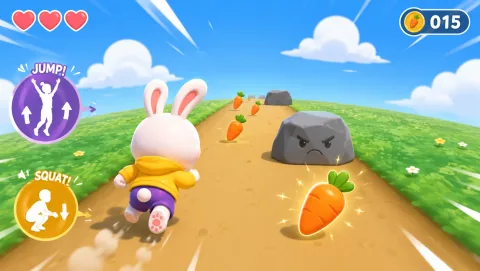
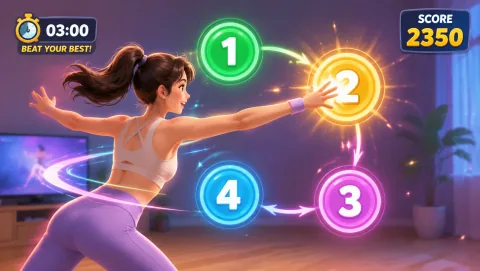
Jumping is easy to understand as a motion-game control: jump over an obstacle, trigger a character jump, land on a beat, or move into a higher target zone.
It also needs more care than many other webcam mechanics.
The player should not have to think constantly about how the tracking system works. Large targets and forgiving timing are useful for learning; complexity can be added after the basic control loop already feels fair. Good recovery keeps one mistake from turning into a frustrating session.
Clear the landing area
Remove rugs that slide, low furniture, cables, and objects near the player. Leave more room than you think you need because people drift during repeated jumps.
Good motion design filters out movement that does not matter to the game. Large targets and forgiving timing are useful for learning; complexity can be added after the basic control loop already feels fair. Good recovery keeps one mistake from turning into a frustrating session.
Physical difficulty and game difficulty do not have to be the same thing. Large targets and forgiving timing are useful for learning; complexity can be added after the basic control loop already feels fair. Good recovery keeps one mistake from turning into a frustrating session.
Readable feedback is part of the control scheme, not decoration. Large targets and forgiving timing are useful for learning; complexity can be added after the basic control loop already feels fair. Good recovery keeps one mistake from turning into a frustrating session.
Keep the camera far enough back
The tracker needs to see enough vertical change without losing the player’s head or feet at the edge of the frame.
A strong motion mechanic makes the connection between body and screen obvious. Players need to know whether they missed the target or the system missed the movement, otherwise every failure feels like bad tracking. Good recovery keeps one mistake from turning into a frustrating session.
Use jumping in short bursts
Jumping becomes high impact quickly. Alternate it with reaching, stepping, or rest rounds instead of making every action a jump.
The player should not have to think constantly about how the tracking system works. Players need to know whether they missed the target or the system missed the movement, otherwise every failure feels like bad tracking. Good recovery keeps one mistake from turning into a frustrating session.
Good motion design filters out movement that does not matter to the game. Players need to know whether they missed the target or the system missed the movement, otherwise every failure feels like bad tracking. Good recovery keeps one mistake from turning into a frustrating session.
Consider the room below you:
Apartments, hotels, and upstairs rooms may be poor locations even if the floor space looks sufficient.
Offer a no-jump alternative
A game is more flexible if the same obstacle can be handled by a squat, lean, or step where appropriate.
Jumping can create energetic gameplay, but it should be chosen because the room and players suit it—not because “active game” automatically means leaving the ground.
Physical difficulty and game difficulty do not have to be the same thing. Players need to know whether they missed the target or the system missed the movement, otherwise every failure feels like bad tracking. Good recovery keeps one mistake from turning into a frustrating session.
Judge the format by the device and the room
Best fit: start here when the device is already available, the camera view is understandable, and the activity can be completed without moving furniture or sharing more video than necessary.
Limit: it is a weaker choice when the connection is unstable, the frame is crowded, the light makes tracking unreliable, or the player needs a movement the camera cannot read consistently.
If you are choosing: If you are choosing between a digital and an offline version, test the first cue before choosing the game. Use the offline option when it gives clearer feedback or a more comfortable way to participate.