A rainy evening usually does not need a complicated activity plan. The useful options are the ones a family can start after dinner, with limited setup, and stop before bedtime without turning the living room upside down.
Here are several modes worth keeping in rotation.
Family play works best when it leaves room for different ages and different levels of enthusiasm. Spectator-friendly feedback and obvious goals help grandparents, children, and guests join at their own pace. That flexibility is usually what makes a family game worth bringing back.
Formats that work well for families
Run a short family tournament
Pick three quick events:
- sock toss accuracy;
- balance challenge;
- reaction game;
- paper-airplane target landing;
- one-minute drawing round.
Keep scores if the family likes competition; skip them if it becomes too serious.
Mixed-age groups usually work better when the same game can be played for a personal best as well as for a winner.
Play a one-screen game
A shared screen is different from four people scrolling separately. Use a trivia game, drawing game, cooperative puzzle, or motion game that supports short turns.
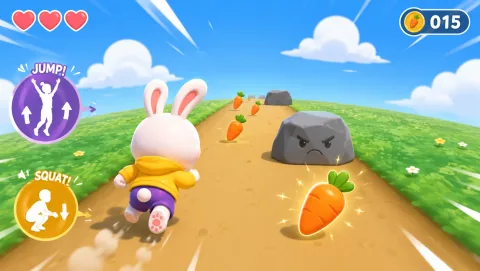
MovePlay can work as one station: one family member plays in front of the webcam while others watch, call suggestions, or keep score. AwkwardPose is especially suited to a social setting because the pose itself is part of the entertainment.
If one person is hesitant, let them watch a round or take a scorekeeping role before asking them to perform.
Cook something small
Choose a recipe that is part activity, part dessert: microwave mug cake, decorated toast, fruit skewers, popcorn mix, or a simple no-bake snack.
This is usually more manageable than starting a full baking project late in the day.
A family game is easier to repeat when setup takes less time than explaining whose turn it is.
Try a family quiz
Each person writes three questions. They can be about family memories, music, films, places, or “who is most likely to…” prompts.
Young children can draw their questions instead.
Mixed-age groups expose weaknesses in a game very quickly. Spectator-friendly feedback and obvious goals help grandparents, children, and guests join at their own pace. That flexibility is usually what makes a family game worth bringing back.
Build a 20-minute project
Use what is already available: blocks, cardboard, paper, magnetic tiles, or LEGO. Set one clear challenge, such as building the longest bridge or a shelter for a toy.
Keep turns short enough that the people watching remain part of the moment instead of starting a separate conversation.
Finish with something quieter
A rainy evening benefits from a change in intensity. After active play, switch to cards, a puzzle, reading, or a short family show.
The goal is not to avoid screens or maximize activity. It is to give the evening a little shape so “we’re stuck inside” does not automatically become everyone spending the whole night on separate devices.
How to keep more people involved
A family game is partly about the people who are not holding the controller. Spectator-friendly feedback and obvious goals help grandparents, children, and guests join at their own pace. That flexibility is usually what makes a family game worth bringing back.
One thing I would not ignore:
The social rhythm matters as much as the rules. Spectator-friendly feedback and obvious goals help grandparents, children, and guests join at their own pace. That flexibility is usually what makes a family game worth bringing back.
What makes the format last
For a household or gathering, I would judge the game by the whole room rather than the most competitive player. Spectator-friendly feedback and obvious goals help grandparents, children, and guests join at their own pace. That flexibility is usually what makes a family game worth bringing back.
Choose it for the group in front of you
Best fit: this works when the ages and confidence levels can share one simple goal, with an adult able to explain the first round and step in if the room loses focus.
Limit: it is a weaker choice when children are tired, the ages are far apart, or one person is expected to perform in front of everyone. A quieter role or a shorter round may be the better answer.
If you are choosing: start with the smallest version that can succeed in the available space. Add speed, scoring, or competition only after the group understands the basic action.