After-school programs need indoor activities that work repeatedly, with mixed ages, changing attendance, and limited staff preparation. A one-off craft can be useful, but a strong program also needs formats that can return every week without feeling identical.
In a classroom, an activity has to work for the teacher as well as the students. A final freeze, countdown, seated cue, or retrieval question can make a two-minute break genuinely useful instead of creating five minutes of recovery. If another teacher can run it tomorrow from a short note, the format is probably strong.
Reliable formats to keep in rotation
Rotation stations
Set up three or four broad activity types:
- movement;
- making/building;
- quiet games;
- digital or media.
Children rotate or choose within staff-defined limits.
Decide in advance what happens when attendance is twice what you expected.
Movement station
Use reaction commands, balance, dance, target games, or a browser motion game. Choose activities that can reset quickly between groups.
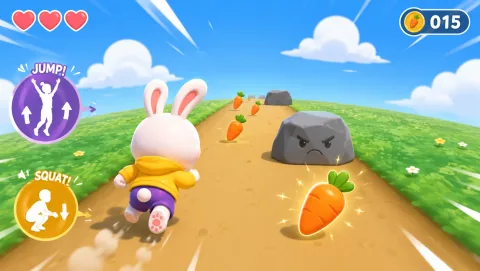
A webcam station can work with one laptop and short turns. MovePlay’s reaction and pose formats are easier to rotate than long progression-based sessions.
A quiet alternative is worth keeping beside every high-energy option.
Maker challenge
Give one constraint rather than detailed instructions:
- build the tallest paper tower;
- create a bridge from limited materials;
- design a marble route;
- make a vehicle for a toy.
Constraints make the same materials reusable for many sessions.
Reuse the format with a new theme before inventing an entirely new activity.
Group games
Use charades, team trivia, drawing relays, cooperative puzzles, or movement memory.
Avoid elimination formats that leave children sitting out.
If the activity depends on one specific device or room, document a fallback at the same time.
Quiet zone
Provide reading, puzzles, drawing, LEGO, or homework support. After a school day, not every child wants more stimulation.
Write the setup in a few lines so another adult can run it without needing a verbal handover.
Theme weeks
Use broad themes such as space, sports, music, inventions, weather, or countries. The movement, art, and game stations can all connect loosely to the theme without turning the program into another class.
Build a reusable activity bank
After-school staff benefit more from 20 proven formats with variations than from 200 unrelated ideas.
Track which activities work by age, group size, room, and setup time. Over time, that internal knowledge becomes more useful than any generic list from the internet.
What makes it repeatable
The most important classroom detail is often the transition nobody puts in the title. A final freeze, countdown, seated cue, or retrieval question can make a two-minute break genuinely useful instead of creating five minutes of recovery. If another teacher can run it tomorrow from a short note, the format is probably strong.
One thing I would not ignore
Teachers benefit more from reliable formats than from endless novelty. A final freeze, countdown, seated cue, or retrieval question can make a two-minute break genuinely useful instead of creating five minutes of recovery. If another teacher can run it tomorrow from a short note, the format is probably strong.
Make it easy to hand over:
The strongest program idea is the one staff can run safely, repeatedly, and with less stress when the day changes.
Make the activity work in the real timetable
Best fit: use this when the teacher can explain one visible rule, keep the first turn brief, and give students a clear way to watch, lead, or pause without being singled out.
Limit: it is a poor fit when setup takes longer than the learning goal, the room cannot be reset safely, or the scoring rewards speed over control. A lower-tech version may teach the same idea better.
If you are choosing: If you are choosing between formats, begin with the option that needs the fewest materials and the least movement across the room. Test one round before committing the whole class.