Mixed-ability PE works better when the activity has several valid ways to contribute instead of one “normal” version and a visibly separate fallback.
The goal is shared participation, not making every student perform the same movement at the same speed.
Adults can improve the format without controlling every minute of it. Preschool groups need forgiving pacing and visible feedback; older children may care more about challenge and whether the activity feels too young. A little structure should make play easier, not turn it into another lesson.
Score accuracy, teamwork, or decisions—not only speed
Fastest-wins formats magnify physical differences. Use target accuracy, team totals, problem solving, prediction, or personal bests instead.
Children's activities change when the social setting changes. A stable format can be reused with different prompts or themes without forcing adults to invent a completely new activity each time. A little structure should make play easier, not turn it into another lesson.
Build seated and standing options into the rules
For a target game, students can throw, reach, point, or direct a partner. For a movement sequence, students can use upper-body actions from a chair or standing full-body actions.
Present both as normal choices.
Avoid over-explaining. Demonstrating one round is often faster than giving a long verbal set of rules.
Use short rotations
Stations make it easier to vary movement demands:
- reaction targets;
- balance or control;
- soft-object accuracy;
- rhythm;
- cooperative build or puzzle;
- low-impact digital movement.
Students spend less time being compared directly.
The same game can behave very differently with siblings, friends, or a preschool group. A stable format can be reused with different prompts or themes without forcing adults to invent a completely new activity each time. A little structure should make play easier, not turn it into another lesson.
Waiting time is one of the most common hidden problems in children's group activities. A stable format can be reused with different prompts or themes without forcing adults to invent a completely new activity each time. A little structure should make play easier, not turn it into another lesson.
Avoid elimination:
A student who misses once should not spend the next ten minutes watching. Use cumulative team points, repeated rounds, or role rotation.
Make difficulty adjustable without announcing it:
Change target distance, size, timing, movement range, or number of steps. Quiet adaptation is usually more inclusive than publicly assigning an “easy version.”
Use technology only when it expands access
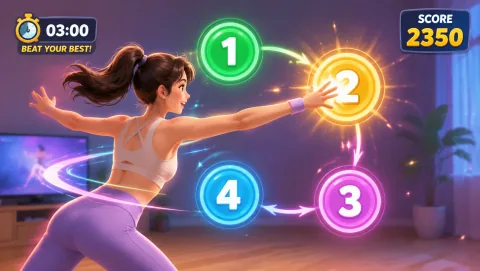
A webcam game can support seated, upper-body, or large-target play if the game has actually been tested that way. Do not claim accessibility based on what the interface might support in theory.
Inclusive PE is not a single game type. It is a design approach that gives students meaningful ways to participate without turning difference into the main event.
For younger children, a quick first success matters more than a sophisticated rule set. A stable format can be reused with different prompts or themes without forcing adults to invent a completely new activity each time. A little structure should make play easier, not turn it into another lesson.
Make the activity work in the real timetable
Best fit: use this when the teacher can explain one visible rule, keep the first turn brief, and give students a clear way to watch, lead, or pause without being singled out.
Limit: it is a poor fit when setup takes longer than the learning goal, the room cannot be reset safely, or the scoring rewards speed over control. A lower-tech version may teach the same idea better.
If you are choosing: If you are choosing between formats, begin with the option that needs the fewest materials and the least movement across the room. Test one round before committing the whole class.