When parents search for ways to “burn off energy,” they usually are not looking for a formal workout. They need a safe outlet for a child who has been sitting, stuck indoors, or simply has more physical energy than the room seems able to hold.
The practical answer is repeated movement with clear boundaries—not exhausting the child at all costs.
In a real home, the deciding factor is often not how creative an activity sounds but how quickly a child can understand it. A five-minute game that starts cleanly can be more useful than a complicated project that consumes the whole afternoon. That is the difference between an idea worth saving and one that only works once.
How I would choose
For family use, I would put ease of starting ahead of novelty. A five-minute game that starts cleanly can be more useful than a complicated project that consumes the whole afternoon. That is the difference between an idea worth saving and one that only works once.
Use movements that work indoors
Running is not the only way to create an active session. In limited space, use actions that stay mostly in place:
- squats and stand-ups;
- fast marching;
- high knees at a controlled pace;
- side steps;
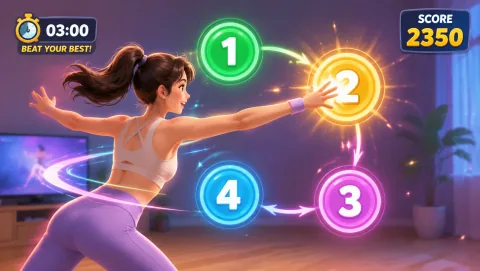
- reaching to targets;
- arm swings;
- balance switches;
- safe jumping if noise and floor conditions allow it.
These can be turned into games with timers, scores, colors, or simple commands.
Make the activity goal-based
Children often stay engaged longer when movement is attached to a task.
Instead of “do 20 squats,” try:
- squat every time a red card appears;
- reach to collect imaginary objects;
- move left or right to dodge a cue;
- beat a previous score;
- copy a movement sequence;
- complete five one-minute challenges.
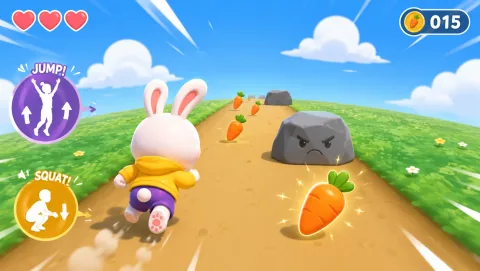
This is also where motion games can help. In SquatPacman, the squat is part of the game control rather than an exercise set. Reaction and Whack A Mole use repeated reaching. The useful feature is not that a game magically makes movement healthier; it gives the movement a reason.
Use short rounds
Ten active minutes can be easier to start than announcing a “workout.” You can always add another round if the child wants to continue.
A simple indoor session might be:
- two minutes of marching and reaching;
- three minutes of a reaction game;
- one minute of water;
- three minutes of balloon or target play;
- one slow balance challenge to finish.
Do not confuse energy with behavior
Some children need movement. Others are hungry, tired, overstimulated, or frustrated. If activity makes the situation worse, more intensity is not automatically the answer.
For younger children especially, movement can be followed by a predictable calm transition: water, snack, reading, bath, or another familiar routine.
Make the room the constraint
Clear enough space for the activity you choose. Move chairs if necessary, avoid hard corners, and do not add jumping in an upstairs apartment just because a list says it is “high energy.”
The best indoor outlet is one you can repeat safely. Controlled, game-like movement usually works better than trying to recreate a playground inside the house.
One thing I would not ignore
The practical test is what happens after the first burst of excitement. A five-minute game that starts cleanly can be more useful than a complicated project that consumes the whole afternoon. That is the difference between an idea worth saving and one that only works once.
What I would keep:
The aim is not to manufacture exhaustion. Give the energy a job, then make the next transition easier.
Choose it for the group in front of you
Best fit: this works when the ages and confidence levels can share one simple goal, with an adult able to explain the first round and step in if the room loses focus.
Limit: it is a weaker choice when children are tired, the ages are far apart, or one person is expected to perform in front of everyone. A quieter role or a shorter round may be the better answer.
If you are choosing: start with the smallest version that can succeed in the available space. Add speed, scoring, or competition only after the group understands the basic action.