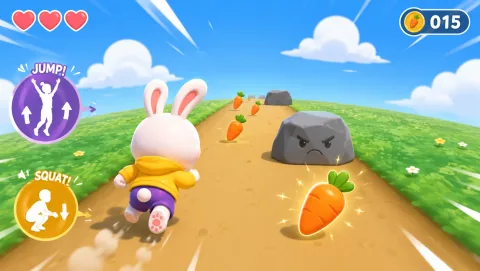
The hardest part of choosing an active game is not finding one that makes a child move. It is finding one they will voluntarily play after the novelty wears off.
Replay value usually comes from gameplay fit, not from how healthy the product sounds to the parent.
The label on the app matters less than the behavior it produces. Parents still need to protect sleep, offline play, social time, and periods where no device is directing attention. The point is balance and intention, not finding a loophole around screen limits.
Formats worth considering
Check how quickly the game becomes fun
For younger players, a long tutorial is a major barrier. The first successful action should happen quickly.
Games such as whack-a-mole, fruit slicing, target touching, or simple dodging are easy to understand because the cause and effect are obvious.
Try it for one clearly bounded session before deciding whether it deserves a regular place in the routine.
Look for short rounds and meaningful improvement
Replay works well when a child can see progress: a higher score, longer streak, faster reaction, cleaner sequence, or harder difficulty.
MovePlay’s Reaction, for instance, supports repeated score attempts, while SquatPacman uses a simple movement pattern that becomes easier as the player learns the timing.
The important part is not the brand. It is whether the child can understand what they did better on the next attempt.
When evaluating digital play, I would look past the word 'educational' or 'active' on the product page. Parents still need to protect sleep, offline play, social time, and periods where no device is directing attention. The point is balance and intention, not finding a loophole around screen limits.
Do not over-reward it
If a game needs a sticker chart, prize, and parental speech to get played, the game itself may not be a strong fit.
External rewards can help establish routines, but repeated voluntary play is a better signal of genuine interest.
If the child enjoys the format but not the specific title, change the game before changing the entire category.
Let children drop games
Not every child will like every movement format. Give them permission to stop and try something else.
For parents, the practical test is simple: after the first week, which games does the child ask for without being prompted? Those are the ones worth building into the routine.
For family use, consider whether another person can understand what is happening without needing their own device.
How I would judge the screen activity
Screen time becomes easier to reason about when you stop treating every screen activity as the same thing. A good digital activity earns its place by adding something useful rather than merely occupying time. The point is balance and intention, not finding a loophole around screen limits.
Start with what the child already likes
Look at their existing preferences.
Do they like:
- racing and dodging;
- rhythm and music;
- quick reaction games;
- puzzles;
- competition;
- silly social games;
- collecting and progression;
- beating personal scores?
A child who loves rhythm may replay a dance game far more than a technically “better workout” that does not match their interests.
Match the movement to the room
A game that constantly fails because the child steps out of frame will not be replayed.
Before choosing a full-body game, check:
- available floor area;
- camera distance;
- ceiling height if jumping is involved;
- noise restrictions;
- whether siblings or furniture share the space.
Hand and upper-body games are often easier to repeat in small homes.
One thing I would not ignore
For parents, the more useful distinction is what the child is doing with the screen. A good digital activity earns its place by adding something useful rather than merely occupying time. The point is balance and intention, not finding a loophole around screen limits.
A better family rule
A screen can support very different behaviors, from passive viewing to creating, talking, solving, or moving. A good digital activity earns its place by adding something useful rather than merely occupying time. The point is balance and intention, not finding a loophole around screen limits.
Choose it for the group in front of you
Best fit: this works when the ages and confidence levels can share one simple goal, with an adult able to explain the first round and step in if the room loses focus.
Limit: it is a weaker choice when children are tired, the ages are far apart, or one person is expected to perform in front of everyone. A quieter role or a shorter round may be the better answer.
If you are choosing: start with the smallest version that can succeed in the available space. Add speed, scoring, or competition only after the group understands the basic action.