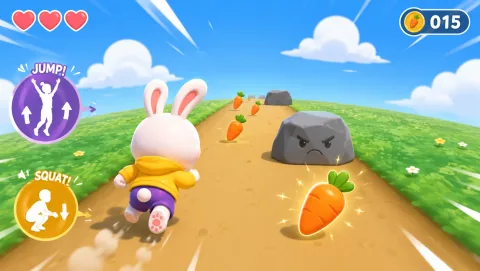
If a child likes screens but resists exercise, “we’re replacing your videos with a workout” is not a promising sales pitch. Active screen time works better when it still feels like play.
The goal is to change part of the screen routine, not to make every digital minute productive.
The label on the app matters less than the behavior it produces. A finite round is easier to manage than an endless feed, and active input is different from simply letting a video run. The point is balance and intention, not finding a loophole around screen limits.
Let the game create the movement
Avoid constantly commenting on the exercise value. If the child is squatting because the game requires it, you do not need to count every repetition out loud.
In MovePlay’s SquatPacman, for example, the movement is the control. In Fruit Slash, large arm swipes are simply how the player interacts. The game objective should stay in the foreground.
The useful test is whether the child stays involved in making decisions rather than sliding back into passive watching.
Rotate active and passive choices
A practical family routine might include:
- one show;
- one active game;
- creative screen time;
- screen-free play.
This avoids turning active games into a punishment for wanting entertainment.
When evaluating digital play, I would look past the word 'educational' or 'active' on the product page. A finite round is easier to manage than an endless feed, and active input is different from simply letting a video run. The point is balance and intention, not finding a loophole around screen limits.
How I would judge the screen activity
Screen time becomes easier to reason about when you stop treating every screen activity as the same thing. The same device can be part of a creative hour or part of a passive one; context decides which it is. The point is balance and intention, not finding a loophole around screen limits.
Start with the child’s preferred game style
Movement alone is not enough to make a game appealing.
A child who likes fast reaction games may enjoy target-hitting. A child who likes rhythm may prefer dance or music. Another may prefer competition, silly poses, or a score to beat.
Choose the play pattern first, then the movement level.
Keep the first session short:
Five to ten minutes is enough to find out whether the child wants to play again. Do not announce a 30-minute “active screen session” before they know the game.
End while interest is still high.
Use personal challenges carefully
“Can you beat your own score?” is often more sustainable than constant parent-versus-child competition.
Keep score if the child enjoys it; ignore it if they do not. Some children replay because of mastery, others because the game itself is funny or satisfying.
Make setup invisible:
An activity feels like a chore if it starts with ten minutes of technical work. Save familiar sites, test camera permission in advance, and keep the play space easy to clear.
If the setup regularly takes longer than the game, the routine will not last.
Do not use “active” as a moral label
Children do not need to feel guilty when they watch a show. Active screen time is simply another option for making digital life more varied.
The best sign that it is working is not that the child knows it is “better screen time.” It is that they voluntarily ask to play again.
One thing I would not ignore
For parents, the more useful distinction is what the child is doing with the screen. The same device can be part of a creative hour or part of a passive one; context decides which it is. The point is balance and intention, not finding a loophole around screen limits.
What matters more than the label
A screen can support very different behaviors, from passive viewing to creating, talking, solving, or moving. The same device can be part of a creative hour or part of a passive one; context decides which it is. The point is balance and intention, not finding a loophole around screen limits.
Choose it for the group in front of you
Best fit: this works when the ages and confidence levels can share one simple goal, with an adult able to explain the first round and step in if the room loses focus.
Limit: it is a weaker choice when children are tired, the ages are far apart, or one person is expected to perform in front of everyone. A quieter role or a shorter round may be the better answer.
If you are choosing: start with the smallest version that can succeed in the available space. Add speed, scoring, or competition only after the group understands the basic action.